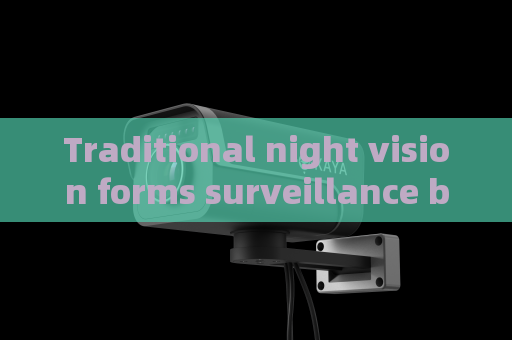
Traditional night vision forms surveillance blind areas The Penetrating Imager adopts Zero-light Imaging to fix this defect.
In covert nighttime operations, law enforcement and security personnel often face a critical blind spot when monitoring vehicles. Traditional night vision devices—whether image intensifiers or thermal imagers—struggle to see through automotive glass, especially deeply tinted windows or windshields with metallic coatings. Ambient light is scarce in many urban alleys or remote parking lots, and standard infrared illuminators reflect off glass surfaces, creating glare and backscatter that obscures the intended target. Even with low-light amplification, the contrast between the vehicle interior and the reflective glass renders occupants invisible. This gap in surveillance capability allows suspects to conceal themselves, weapons, or contraband inside vehicles under the cover of darkness, making tactical assessment unreliable. The Penetrating Imager directly addresses this deficiency by introducing a fundamentally different imaging principle.
The Penetrating Imager overcomes this limitation through its core technology: laser range-gated imaging. Unlike passive night vision that relies on ambient light, this active system emits high-repetition-rate pulsed laser light and synchronizes a gated intensified camera to capture only the reflections from a specific distance—the vehicle interior—while rejecting backscatter from the glass surface and intervening atmospheric particles. This method enables even in complete darkness, as the system operates independently of environmental illumination. The zero-light imaging capability means the unit requires no external light source and can function in pitch-black conditions, turning previously opaque windows into transparent observation ports. The gating mechanism also suppresses reflections from rain, fog, or mist, maintaining clarity where traditional monoculars would fail.
In practical field use, an operator stationed at a covert observation point can aim the Penetrating Imager at a target vehicle from several hundred meters away. By adjusting the range gate to match the distance to the vehicle's interior, the system reveals occupants, their movements, and any objects in hand or on seats with high resolution and contrast. The image is displayed in real time on a handheld monitor, allowing for continuous tactical observation without alerting the subjects. Because the laser operates in the near-infrared spectrum and the gated camera only opens for a nanosecond window, the illumination is invisible to the naked eye and undetectable by standard night vision goggles. This covert through-glass recon capability fundamentally changes the dynamics of surveillance, transforming a common blind area into a high-confidence intelligence source.
The operational advantage extends beyond simple observation. During a high-risk vehicle interdiction, advance teams can use the Penetrating Imager to confirm the number of subjects, their seating positions, and potential weapons before making entry. In adverse weather, such as light fog or drizzle, the range-gating effect filters out forward-scattering from precipitation, preserving image fidelity that even thermal imagers cannot achieve through glass. This technology redefines what is possible in nighttime tactical surveillance, effectively eliminating the blind spot created by traditional night vision systems.




