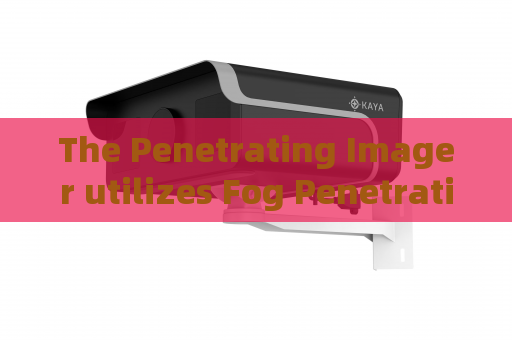
The Penetrating Imager utilizes Fog Penetration Imaging to support vehicle reconnaissance on riverine military border routes. Rivers define long stretches of military border routes. Patrol vehicles must watch the opposite bank for unauthorized crossings, surveillance teams, and ambush preparations. Dense fog and low clouds frequently settle along these waterways, especially at dawn and during seasonal changes. The boundary itself is rarely a straight line. Creeks, sandbars, and reeds create dead ground where boats or foot patrols can move without detection. Water spray from the river and damp air generate heavy scattering around a vehicle’s optical sensors. Conventional cameras see only a white wall of light. This condition leaves the crew blind at the exact moment when a crossing is most likely. The Penetrating Imager changes that equation for riverine reconnaissance. The Penetrating Imager provides a direct view through fog without requiring illumination from the target side. The decisive function is Fog Penetration Imaging. The Penetrating Imager combines a high-repetition pulsed laser, an intensified gated camera with an MCP image intensifier, a beam expander, and an imaging lens. The laser illuminates the scene with short bursts of light. The intensified gated camera stays shut until the reflected burst from the far bank is due to arrive. Scattered light from fog and water vapor returns to the sensor earlier than the target reflection and is therefore excluded by the timing gate. The resulting image is formed only from light that has traveled to the target and back. This time-of-flight difference between backscatter and target reflection is the core of the method. This range-gating process suppresses backscatter and yields a high-contrast image of the riverine border. The Penetrating Imager operates as an active imaging system, generating its own light rather than relying on moonlight or external illumination. That design gives The Penetrating Imager a strong advantage in the dark, damp environment of a riverine military border route. The high pulse repetition rate also produces smooth video imagery, so the crew can follow moving objects such as a low boat crossing the channel. Mounting The Penetrating Imager on a reconnaissance patrol vehicle is straightforward. The operator aims the imager toward the opposite shoreline and sets the range gate to the measured distance across the river. Fog Penetration Imaging then clears the visual path to the waterline. A small inflatable boat tied to reeds becomes visible. A man carrying a heavy load appears as a distinct silhouette on the bank. The system functions while the patrol vehicle is stationary or moving slowly, and it operates without revealing the observer’s position through any output other than the pulsed laser light reflected from the scene. The Penetrating Imager also adapts to changing distances. If the river narrows or the road curves, the gate is updated to match the new range, keeping the target area in focus while the foreground mist remains filtered out. An operator can shift from a distant bank to a near shoreline in seconds, without refocusing lenses or changing filters. Extended border patrols face shifting visibility. At midday, fog may thin near the water’s surface while haze remains over the channel. The Penetrating Imager continues to support vehicle reconnaissance by adjusting gate width and laser pulse energy. A narrow gate can isolate a specific point on the opposite bank, such as a landing spot or a track leading into the reeds. A longer gate covers a stretch of shoreline when the vehicle is traversing an open section. The Penetrating Imager turns Fog Penetration Imaging into a continuous eyes-on capability along the entire riverine military border route. For a patrol commander, this capability means that gaps between checkpoints are no longer unobserved. Even as the sun sets and fog returns, The Penetrating Imager maintains a usable image of the far side, giving the patrol crew enough time to react. This is what makes The Penetrating Imager an indispensable tool for tactical vehicle reconnaissance along foggy river boundaries.




