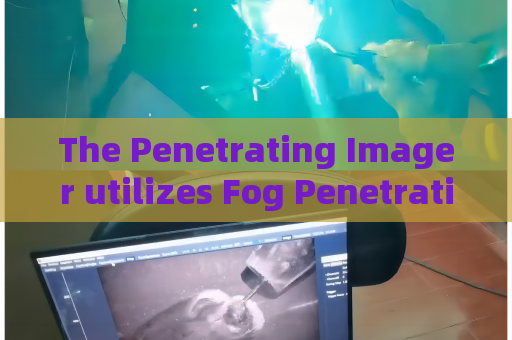
The Penetrating Imager utilizes Fog Penetration Imaging to support vehicle reconnaissance on riverine military border routes. A riverine military border route presents one of the most demanding visual environments for vehicle reconnaissance. Dense fog rolls off the water surface in the early morning, mixing with exhaust fumes and ground mist. A target vehicle approaching along the levee road becomes a vague shape against the grey background. Rain and river spray add another layer of scattered light. The operator behind a standard binocular or telescopic sight must identify whether the vehicle is a friendly supply truck or a hostile scout carrier. Windshield glass compounds the problem: windows reflect the overcast sky and surrounding vegetation, while dirt and water droplets on the glass smear the interior view. The real pain is not simply seeing a vehicle, but seeing through the combined optical noise of fog, spray, and glass. In such a scenario, the Penetrating Imager becomes necessary. The Penetrating Imager utilizes Fog Penetration Imaging to cut through this optical noise. The system is an active optical imager based on laser range-gated technology. A high-repetition pulsed laser illuminates the scene, while an intensified gated camera opens only for the short moment when the reflected light from the target distance returns to the sensor. This time-gating principle rejects the backscattered light from fog particles that lie between the imager and the vehicle. The result is a clear, high-contrast image of the target even when atmospheric visibility drops to a few dozen meters. For border reconnaissance, this capability enables through-window tactical observation as well: the gated camera sees the vehicle’s windscreen and side windows not as reflective surfaces, but as optical media that the pulsed light can pass through and return from. The system overcomes both fog penetration and glass-penetrating imaging in one measurement cycle, without relying on any non-optical means. Deployment along the riverine route puts this function to immediate use. A border patrol vehicle is positioned on a raised riverbank, with the Penetrating Imager mounted on a stabilized tripod beside a low observation window. The operator selects the approximate distance to the approaching vehicle using the ranging information from the laser. Once the range gate is set, the imager releases a sequence of short light pulses. The gated camera captures only the reflection from the vehicle body and cabin interior, ignoring the thick fog that hangs across the channels. On the display, the outline of the truck or SUV appears sharply etched. The operator can count the occupants behind the windshield, note the position of their hands, and detect any unusual shape on the dashboard. If the vehicle has tinted glass, the system still produces a usable image because the near-infrared pulse penetrates the glazing and returns with the interior’s optical signature. The same riverine scene changes throughout the day, yet the Penetrating Imager maintains its advantage. At noon, heat haze above the asphalt causes shimmering, while late afternoon brings low-angle sun glare off the river surface. Even then, the time-gated active illumination suppresses the glare and haze, because only the laser pulse returning from the target plane is integrated. During a sudden rain squall, the system continues to output stable imagery; the gated camera simply rejects the raindrops that reflect light back from the foreground. This operational persistence is crucial for military border routes, where a vehicle may emerge from a dense fog bank with only thirty meters of warning distance. The Penetrating Imager gives that warning a clear visual basis, transforming a ghostly pair of headlights into a recognizable platform with a defined crew compartment. Every riverine patrol shift relies on this optical edge to make the right call before the vehicle reaches the checkpoint.




