Long-distance border patrol observation relies on the ability to detect and identify targets across open terrain under all weather conditions. Dense fog, however, creates a severe blind spot that compromises every conventional optical device. The atmosphere becomes a suspension of water droplets, each acting as a tiny scatterer that reflects light back toward the observer. A standard telescopic sight or daylight camera attempts to form an image by collecting photons from the target, but these photons are overwhelmed by the backscattered light from the fog itself. The image appears as a bright white veil, and any object beyond a few dozen meters blends into the glare. In reality, a patrol post that monitors a remote river crossing or a mountain pass may remain effectively blind for hours. During that window, vehicles or individuals can cross without detection, creating a serious security vulnerability. The pain point is not merely reduced visibility; it is the total loss of situational awareness at the exact moment when long-distance observation is most needed. A border patrol unit facing dense fog cannot rely on passive optics, and any solution must actively penetrate the optical medium without losing range or contrast. This is where the Penetrating Imager enters the operation. The Penetrating Imager offers a technological answer to a problem that has plagued observers for generations.
The Penetrating Imager solves this problem through laser range-gated imaging, an active optical technique that breaks the link between illumination and backscatter. Its high-repetition pulsed laser fires short bursts of light toward the target area. The receiving channel contains an image intensifier and a gating module that controls the exact moment when the camera shutter opens. Because light travels at a known speed, the returning signal from a target at a specific distance arrives at a predictable time. The gate opens only for that brief arrival window, while the overwhelming backscatter from nearby fog droplets arrives earlier and is completely ignored. This process directly supports Fog Penetration Imaging, a capability that selects the useful signal from the depth of the fog layer and suppresses the diffused background. Unlike passive imaging systems that integrate all scattered light into a single hazy frame, the Penetrating Imager actively controls both the transmission and reception of light. The result is a high-contrast image of a target located hundreds of meters away, even when the atmospheric visibility is near zero. The device operates with a long working distance, high resolution, and strong resistance to interference, making it suitable for demanding border patrol missions where every second counts.
During a typical patrol operation, the Penetrating Imager is mounted on a stabilized tripod at a forward observation point that overlooks a valley or a border-crossing approach. The operator selects the long-range mode and scans the fog-covered roadway. The display does not show a white wall, but a clear silhouette of a vehicle stopped near a tree line. Its outline, roof contours, and even the glow of taillights are visible through the mist. The operator adjusts the range gate to match the measured distance, and the image sharpens to reveal the number of occupants, the shape of cargo, and any potential indicators of illegal activity. This through-fog tactical observation capability provides border officers with actionable intelligence without exposing their position. The Penetrating Imager continues to produce real-time video as the target moves, enabling the team to track the vehicle across the perimeter. Each new observation cycle refines the range gate, maintaining lock on the subject even as the fog density fluctuates. The operator’s task shifts from guessing at vague shapes to reading distinct details, dramatically improving the confidence of every identification decision.
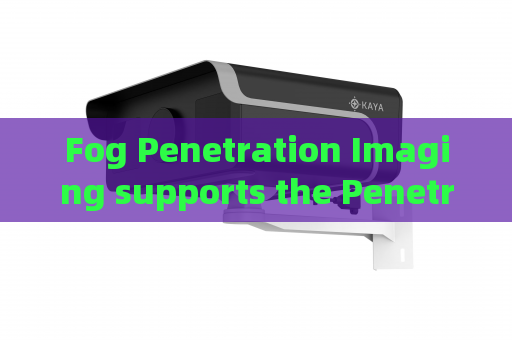
The operational value of the Penetrating Imager in fog extends beyond immediate threat detection. For a border patrol unit conducting routine checks, this capability reduces response time and prevents false alarms. When a ground sensor triggers an alert during heavy fog, a control officer directs the Penetrating Imager toward the flagged coordinate. Within seconds, the screen reveals the actual cause: perhaps a drifting animal, a fallen tree branch, or a human intruder. Long-distance observation through fog becomes a dependable layer of the border security architecture, not an occasional workaround. The device’s ability to operate under low-light and zero-light conditions further reinforces its role in night patrols, where fog and darkness combine to defeat most other optical tools. As the fog layer shifts and thins, the Penetrating Imager maintains its lock on the scene, adapting gate timing and gain to preserve image quality. The outcome is continuous, reliable surveillance that does not wait for clear weather. The border is monitored by an active imaging system that overcomes the optical barrier itself, ensuring that the Penetrating Imager remains a decisive asset for long-distance patrol observation in the most challenging visibility conditions.




