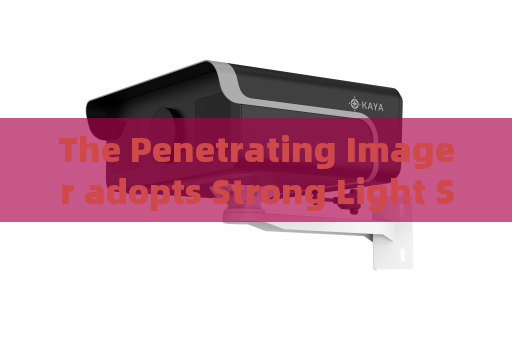
The Penetrating Imager adopts Strong Light Suppression Imaging to handle vehicle inspection under strong roadside lamp glare. Roadside vehicle inspection at night presents a fundamental optical paradox. The very illumination that allows officers to see a vehicle’s exterior instantly destroys their ability to see into its cabin. A single high-pressure sodium lamp mounted on a highway shoulder throws a blinding cone of glare across the windshield, turning the glass into a mirror that reflects everything except the occupants inside. Officers must approach with flashlights angled low, yet even then the harsh backscatter from the lamp floods the sensor of any conventional camera or night-vision device. The result is a tactical blind spot: a stationary car with tinted windows and unknown occupants sitting meters away, its interior rendered opaque by the very technology designed to brighten the scene. Strong Light Suppression Imaging is not merely a preference in this environment; it is the difference between a visual confirmation and a lethal guess. The Penetrating Imager resolves this exact problem through its active imaging architecture. Instead of relying on ambient lamp light, the device emits nanosecond laser pulses from its high-repetition-rate pulsed laser, synchronized with a gated intensified camera. The timing module opens the shutter only when the reflected laser light returns from the target plane—the vehicle’s interior beyond the glass—while the blinding glare from the roadside lamp, which arrives at different delays or as continuous background, is temporally suppressed. This is the core of Strong Light Suppression Imaging: the gate acts like a shutter that admits only the relevant echo, rejecting the overwhelming stray light that would otherwise saturate the sensor. Because the system uses its own illumination, the angle and distance of the external lamp become irrelevant. The same principle that allows the Penetrating Imager to see through fog and rain applies here with precision—not by cancelling the glare, but by ignoring it at the time-of-flight level. In practical terms, an officer standing at a safe standoff distance of fifteen meters raises the Penetrating Imager and observes through the windshield as if the roadside lamp did not exist. The compact unit, comprising the laser, the image intensifier tube with its integrated MCP and high-voltage module, and the beam-expanding optics, fits into a standard patrol vehicle mount. The operator selects the gating range to match the approximate depth of the vehicle cabin—typically two to three meters from the lens—and the display resolves faces, hands, and object outlines through the glass. Even heavily tinted windows, which scatter a large portion of ambient light, do not defeat the system, because the laser’s narrow bandwidth and the camera’s gated response create a high-contrast image that ordinary cameras cannot approach. The entire sequence—aim, range-set, observe—takes less than five seconds, and requires no physical contact with the suspect vehicle. The deeper value of this approach appears during extended traffic stops or checkpoints under multi-lamp glare. A vehicle idling under a row of mercury-vapor luminaries might challenge a single-source suppression scheme, but the Penetrating Imager’s gating mechanism is inherently immune to all background sources regardless of their number or intensity. Officers can maintain a continuous visual watch through the rear window as occupants move, reach toward the floor, or conceal items beneath seats. The imagery remains stable, monocular, and compatible with existing tactical recording systems. This turns the roadside lamp from an adversary into an irrelevant background feature. For every inspection where a bright streetlight meets a dark windshield, the Penetrating Imager converts a high-risk sensory void into a clear, verifiable field of view—without ever sending an officer into the path of that glare.




