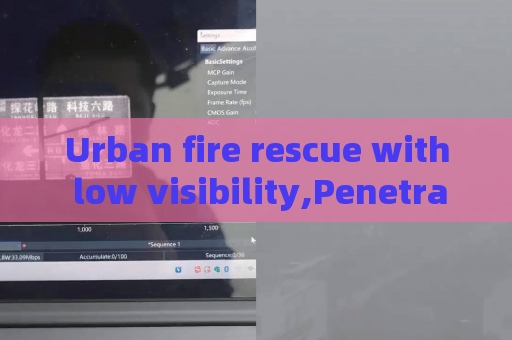
Urban fire rescue with low visibility, Penetrating Imager utilizes Smoke Penetration Imaging to assist on-site reconnaissance Inside a smoke-filled urban apartment, the fire command officer loses sight of the interior within seconds of entry. The combination of turbulent gas layers, fire glow, and water mist from hose streams creates a blinding optical cocktail. Rescue crews on their hands and knees must sweep the floor blindly, every second of delay reducing survivability for any trapped occupant. A conventional flashlight makes the problem worse: its beam scatters off suspended soot particles, producing a gray wall that hides whatever lies three feet ahead. Thermal cameras offer some help but fail to reveal clean edges, furniture shapes, or the orientation of a fallen body. Water spray from the nozzle adds yet another scattering layer, while radio reports from inside become sparse and unreliable. This is the true pain point of on-site reconnaissance — not a lack of heat detection, but a lack of clear visual structure through an optically aggressive medium. A Penetrating Imager is designed to restore that missing visual channel. The capability that solves this problem is laser range-gated imaging. A Penetrating Imager fires high-repetition laser pulses and synchronizes an intensified camera to capture only the light bounced back from a selected distance slab. Photons scattered by the near-field smoke and flame glow are excluded by the timing gate, which effectively performs Fire Penetration Imaging through the turbid atmosphere. This active imaging approach suppresses backscatter and raises the usable visibility inside a fire compartment by a factor of three to five. The operator simply selects the target range, and the system returns a high-contrast frame showing furniture, door openings, and even still-standing structural elements that would otherwise be hidden. The imager does not rely on heat — it relies on gated light reflection, so it can distinguish a human figure from a hot radiator based on shape and depth, not temperature alone. Dense, fully developed black smoke remains outside its optical limit, but the conditions that typically delay early reconnaissance — flickering flames, light to moderate smoke, steam, and airborne ash — no longer block the view. During an actual entry, the Penetrating Imager is carried by the lead firefighter or mounted on a low tripod just outside the door. With the range gate set to eight meters, the live monitor shows a smoke-cleared corridor leading to the kitchen. A faint motionless shape lies on the floor near the refrigerator — the unmistakable outline of a person curled on their side. This visual confirmation replaces a ten-minute blind search with a direct rescue path. The operator reports the coordinates over the tactical channel, and the strike team moves along the cleared path while the Penetrating Imager continues to update the scene. Because the system works purely with light, it can be used safely in flammable atmospheres without introducing ignition sources or electromagnetic interference. On the exterior side of the same fire, a window team directed a Penetrating Imager through the glass balcony door from the aerial platform. The gated optics cut through the smoke layer clinging to the inside of the glazing, revealing a collapsed partition wall and the victim’s hand extended toward the sill. That single observation allowed the rescue team to break the correct window section, avoiding the area where the ceiling was already sagging. The Penetrating Imager thus turns low-visibility urban fire rescue from a haptic guessing process into a rapid, visually confirmed operation. Smoke Penetration Imaging, when combined with a clearly defined range gate, gives the on-site commander a decisive tool for seeing through the fireground chaos and acting before the window of survivability closes. Early visual access during the first three minutes often determines whether a trapped victim walks out or is carried out.




