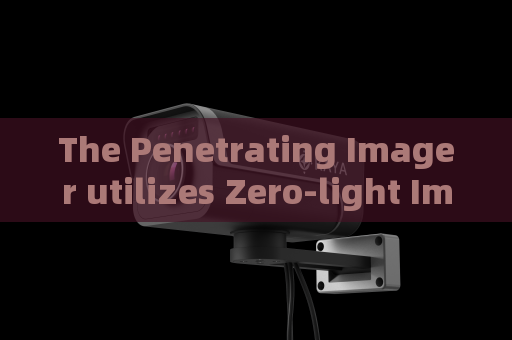
The Penetrating Imager utilizes Zero-light Imaging for quiet vehicle surveillance during night military ambush operations A night ambush team positioned in dense cover faces an intractable problem when a vehicle approaches along a blacked-out route. The occupants remain hidden behind windshields and side windows that are tinted, dust-covered, or spattered with rain. Standard image intensifiers depend on ambient starlight that is often absorbed by overcast skies or filtered out by tree canopy, and thermal imaging is blocked by the glass itself, erasing the human signatures behind it. Switching on a white light or a conventional infrared illuminator would announce the ambush position to any alert driver. The squad commander needs to determine how many people are in the cabin, whether a weapon is raised, and whether the vehicle is friendly or hostile. Every second of uncertainty narrows the engagement window and increases the risk to the team. Without a Penetrating Imager, the squad is forced into a dangerous trade-off between exposing a spotter and launching an attack without any confirmed understanding of what is inside the vehicle. The Penetrating Imager directly answers this problem through covert through-glass recon enabled by laser range-gated imaging. This Penetrating Imager is an active optical instrument carrying its own illumination source: a high-repetition pulsed laser, an image-intensified gated camera with a built-in MCP image intensifier, high-voltage module and timing module, plus a beam expander and imaging lens. The timing circuit opens the camera gate for only a few nanoseconds at the exact moment the reflected pulse returns from the target range. The gate duration and the laser pulse repetition rate are adjustable, allowing the operator to dial in a specific stand-off distance. Light scattered by the glass surface, fog, rain, or airborne particles travels a different distance and is rejected before it reaches the sensor. The gating mechanism suppresses backscatter and produces high-contrast images through windshield glass that would defeat conventional optics. The pulsed laser emission is matched to a wavelength invisible to the naked eye, so the surveillance remains quiet in the truest sense - no visible flash, no audible click, and no by-product that an alert driver could sense. Deployment of the Penetrating Imager in an ambush hide follows a deliberate sequence. The Penetrating Imager is mounted on a lightweight tripod behind natural cover, with the imaging lens trained on a single curve of road where vehicles must slow down. The operator sets the range gate to match the distance measured during an initial reconnaissance. As the vehicle enters the gated zone, the display shows the driver and passengers in realistic optical detail, even through tinted glass and in zero-light conditions. The unit can be linked to a remote monitor at the ambush commander's position, so no operator needs to raise a head or expose a silhouette to confirm the target. The image feed is continuous and real-time, giving the team a tactical picture that remains stable as the vehicle rolls through the gated envelope. The absence of a visible beam also protects the observation post from detection by a vehicle crew scanning the roadside. In the decisive seconds before the ambush is initiated, the intelligence gathered by the Penetrating Imager often determines the outcome. The team can count the number of occupants, detect a weapon laid across a lap, observe a hand reaching toward a door panel, or recognize a friendly unit marking that would otherwise be invisible through the glare of the vehicle's own headlights. A quiet voice onto the tactical net confirms the count; a single hand signal shifts the engagement plan accordingly. The same range-gating technology also overcomes light mist, drifting snow, and the spray kicked up by tires on a wet road, preserving a usable image where other optical tools fail. This focused application of Zero-light Imaging transforms the night ambush from a blind gamble into a deliberate, information-driven operation, preserving surprise while removing the guesswork from a situation that allows no second chance.




