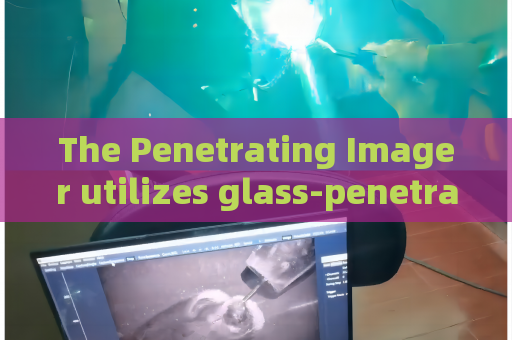
The Penetrating Imager utilizes glass-penetrating imaging to reduce field exposure risks during hostage rescue operations In a hostage rescue operation, the most dangerous moment often comes before any shot is fired. The team must know the hostage-taker's exact position, the condition of the hostage, and the layout of the space, but the space is usually sealed behind glass — a vehicle window, a glass office partition, or a reinforced glass door. Conventional observation forces an operator to approach the window, lean toward the pane, and look through reflections. That movement breaks cover, announces the operation, and puts the operator directly in the line of fire. Reflected light, tinted glazing, and poor weather degrade whatever can be glimpsed. The real problem is field exposure risk: gathering intelligence requires a body near the glass, and a body near the glass is a target. The Penetrating Imager, a gated optical instrument, was developed to break that fatal pattern. The Penetrating Imager takes that dangerous body out of the equation, because it reads what is behind the glass from a position of safety. The capability that solves this problem is glass-penetrating imaging, and the Penetrating Imager implements it with laser range-gated technology. A high-repetition-rate pulsed laser sends a short pulse of light toward the glass through a beam expander. The image-intensified gated camera inside the Penetrating Imager, built around an MCP image intensifier with integrated high-voltage and timing modules, opens only when light reflected from the target space returns through the imaging lens. Reflections from the glass surface and scattered light from mist, rain, snow, or dust arrive outside that time window and are discarded. This is through-window tactical observation achieved purely with light. The Penetrating Imager is an active imaging system, so it does not depend on ambient illumination, and its range gating suppresses backscatter better than any passive optic. The Penetrating Imager operates only against optical media: automotive glass, high-speed rail windows, aircraft portholes, glass curtain walls. It will not see through walls, concrete, or metal, but for a hostage scene dominated by glass barriers, that limitation is irrelevant. Through the Penetrating Imager's display, the operator behind cover sees a high-contrast, high-resolution image of the vehicle interior or the room beyond the glass. Deployment is straightforward. The Penetrating Imager is set up behind a barricade, a corner, or an armoured vehicle. An operator measures the distance to the hostage-taker's position and sets the range gate accordingly. The display shows the hostage-taker, the hostage, and any weapons in real time. In a typical car-stop scenario, the hostage-taker sits behind tinted side windows, unaware that the Penetrating Imager is reading every movement from forty metres away. The assault team receives continuous updates, and the Penetrating Imager feeds the commander's tactical display. As dusk falls, the pulsed laser of the Penetrating Imager keeps the image stable, and the gating suppresses the glare of interior cabin lights. No team member crosses the open field, no mirror slides under a blind spot, and no knock on the glass gives away the surveillance. The Penetrating Imager converts a high-risk visual check into a hands-off, standoff observation. The value of the Penetrating Imager continues into the final seconds of the rescue. When the team decides to breach the glass door or the car window, the commander still watches the live feed. The last image through the glass confirms that the hostage-taker has not moved, that the weapon is still in the same hand, or that a sudden shift signals an impending shot. That confirmation is possible because the Penetrating Imager's range gate can be re-tuned instantly as the team advances. Fog, haze, rain, and snow that would defeat a normal camera do not erase the image, and in a fire scene the instrument still returns a usable picture, although thick smoke remains outside the imager's capability. Every function of the Penetrating Imager stays within the optical spectrum; light is the only medium it emits or receives. The hostage rescue team finishes the operation with the same clear picture that started it. In this scenario, the Penetrating Imager does more than improve vision — it removes the need for a human eye to be anywhere near the glass, and that is what reduces field exposure risk.




