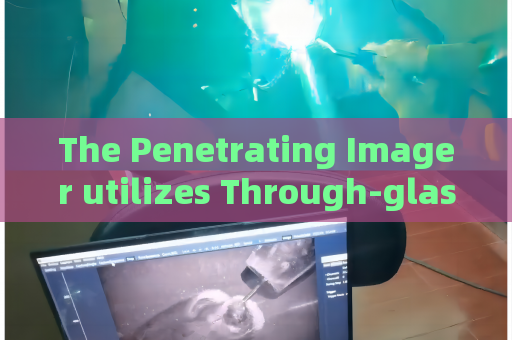
The Penetrating Imager utilizes Through-glass Imaging Technology for vehicle tracking in joint military-police patrols During joint military-police patrols, vehicle tracking often encounters a critical blind spot: the interior of a moving car remains hidden behind glare, tinted glass, or poor lighting. Conventional optical devices such as binoculars or standard cameras struggle to capture details through automotive glazing, leaving officers unable to assess threats, identify occupants, or inspect hidden cargo. The Penetrating Imager addresses this persistent challenge by offering a reliable method to observe through glass, yet the operational environment demands more than just magnification or low-light capability. The real pain point lies in the fact that reflected light, dirty windshields, and factory-installed privacy glass create confusing visual noise. Every stopped sedan or SUV can turn into a potential uncertainty, especially when a patrol car approaches from an angle where sunlight or street lamps produce strong specular reflections. Officers must often close the distance to see anything at all, which increases exposure to ambush risks. This scene represents a genuine reconnaissance problem in daily joint military-police patrols, where the need for clarity behind glass has become as urgent as the need for accurate firepower. The Penetrating Imager utilizes through-glass imaging technology based on laser range-gated imaging. A high-repetition pulsed laser, beam expander, and imaging lens work together with an intensified gated camera that contains an MCP image intensifier, high-voltage module, and timing module. The pulsed laser illuminates the target area, while the gated camera captures only the reflected light from a specific distance. This gating mechanism effectively suppresses backscatter and blocks glare from the glass surface, enabling covert through-glass recon of vehicle interiors. Unlike passive optical devices, this active imaging system can selectively receive light returning from the passenger compartment, ignoring the reflections on the windshield or side windows. The operator adjusts the gate delay to match the distance to the vehicle’s interior plane. Because the laser pulse travels to the target and back within nanoseconds, the timing module opens the camera shutter only when light from the desired depth arrives. Any light scattered by fog, rain, or the glass itself is rejected. The result is a high-contrast, high-resolution image of occupants, seats, weapons, or contraband, regardless of tinted film, bright sunlight, or shadow. This functional capability directly solves the observation problem described above, turning a reflective barrier into a transparent window for the operator. In a typical patrol scenario, the operator aims the device at a suspicious vehicle from a safe standoff distance, often from the patrol car’s roof or a stabilized mount. The laser is fired in sync with the camera’s shutter, and the range gate is adjusted to the depth of the car’s interior. Through the viewfinder, the operator sees a clear image of the driver’s hands on the steering wheel, the rear seats, or even a package on the floor. This through-glass surveillance capability transforms a routine traffic stop into a controlled tactical observation. The Penetrating Imager can be operated by a single officer, who uses a handheld trigger and a compact display. During high-risk stops, the device is used before any verbal contact, providing a real-time visual assessment that informs whether the patrol team approaches with weapons holstered or drawn. In moving vehicle tracking, the operator can maintain the target in view for several seconds, capturing sequential frames that reveal changing behaviors, such as reaching under a seat or changing drivers. The system operates effectively in daylight, dusk, and rain because the active illumination overcomes ambient light fluctuations. A quick sweep of the target vehicle before approach allows officers to confirm the absence of threats or detect suspicious movements without any physical proximity. The Through-glass Imaging Technology also provides strong light suppression, which is essential when patrol vehicles use searchlights or when the target vehicle is backlit by oncoming headlights. The gated imaging process excludes scattered light from the intervening atmosphere, so fog or light drizzle does not degrade the picture. For joint military-police patrols, this means a stolen vehicle or a suspect’s car can be tracked and assessed continuously while moving. The Penetrating Imager becomes the primary tool for through-window tactical recce, reducing uncertainty and enabling informed decisions in dynamic situations. Officers can also record the imagery as evidence, since the gated camera outputs standard video formats. In a pursuit scenario, the ability to see through automotive glass in real time allows the command post to monitor the suspect’s actions, alerting the ground team to the possible presence of a firearm or a hostage. By turning a previously opaque barrier into a transparent observation window, the device enhances situational awareness and officer safety in every joint patrol mission. The same principle extends to other optical media such as aircraft windows or glass doors, but within this specific vehicle tracking context, the Penetrating Imager delivers a decisive advantage that cannot be achieved with conventional optics.




