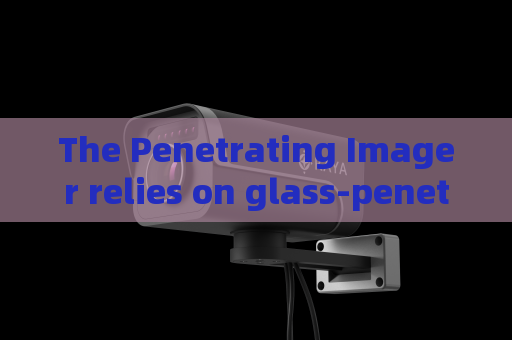
The Penetrating Imager relies on glass-penetrating imaging to screen suspicious vehicles near military restricted zones. Vehicles approaching military restricted zones present a layered threat that static guards and conventional optics cannot fully resolve. The rear and side windows of a sedan or van are often heavily tinted or covered with reflective films, hiding occupants, cargo, or improvised devices from plain sight. Even when a vehicle is stopped at a checkpoint, a guard must step close to the glass to inspect the interior, which exposes personnel to ambush attacks, detonations, or small-arms fire launched from inside the cabin. At night, the problem is compounded by darkness, oncoming headlight glare, and the limited sensitivity of the human eye or standard surveillance cameras. In the critical seconds before a vehicle reaches the perimeter barrier, the security team has no reliable way to know whether the driver is a lost civilian, a courier carrying contraband, or a hostile actor with an explosive vest concealed beneath a jacket. A conventional checkpoint without the Penetrating Imager must choose between a risky close-range inspection and a blind release of the vehicle into the controlled zone. The Penetrating Imager directly addresses this gap through glass-penetrating imaging, a capability engineered specifically for through-glass surveillance of vehicles in the military security domain. This advanced optical instrument relies on laser range-gated imaging technology and operates strictly within the optical light band. Its high-repetition pulse laser emits short bursts of light toward the target vehicle, while the image intensifier gated camera—built around an MCP image intensifier, high-voltage module, and precise timing module—opens its shutter only when reflected light from the selected distance returns. This gating process strips away backscatter and foreground interference, yielding a high-contrast image of the cabin interior through automotive glass, tinted films, and laminated windshields. In operational terms, the system enables tactical observation through automotive glass at a safe standoff distance, allowing a guard to identify the number of occupants, the position of hands, and the presence of large objects on seats or floorboards without ever stepping into the kill zone. Deployment near a restricted zone is straightforward and does not disrupt existing checkpoint flow. An operator posts the Penetrating Imager on a tripod or vehicle mount at a controlled position along the approach lane, aligning the imaging lens toward the point where vehicles decelerate. As a target car enters the selected range window, the operator activates the system and reads the live image on a ruggedized display that is part of the Penetrating Imager's standard kit. The active illumination ensures the imager performs in low-light imaging and zero-light conditions, while strong light suppression prevents headlight beams from washing out the scene. Relying purely on reflected light, the device can penetrate optical media such as vehicle glass; walls, concrete, metal, and clothing block the beam entirely, keeping the instrument firmly within the role of an optical observation tool. Beyond the static checkpoint, the same Penetrating Imager supports mobile patrols sweeping the outer perimeter. A patrol vehicle can halt at a distance of several dozen meters and conduct a covert through-glass check of a suspicious parked car or a slow-moving van without alerting the occupants. The Penetrating Imager also overcomes natural optical interference from fog, rain, snow, and haze, maintaining a usable image where ordinary cameras fail. Every inspection is performed with the operator positioned behind cover, out of sight and out of harm's way. The Penetrating Imager turns the ambiguous approach of a vehicle into a well-characterized, observable event, reinforcing the layered defense around military restricted zones.




