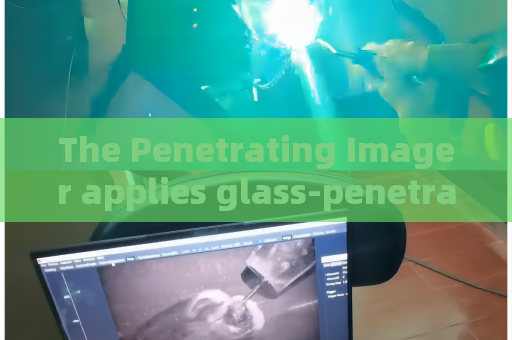
The Penetrating Imager applies glass-penetrating imaging to reduce close-range contact risks in armed police vehicle interception. Armed police vehicle interdiction concentrates the greatest danger in the seconds between the order to halt and an officer’s arrival at the suspect car. A stopped vehicle with tinted side glass and a reflected windscreen is an information-proof box: occupants inside watch the approach while officers outside see little more than glare and distorted shapes. Close-range contact is therefore a blind action. Whether the driver holds a phone or a handgun, whether a rear passenger is leaning toward the floor or toward the door handle, whether the silhouette in the back seat is an adult or a child—all those facts remain hidden until an officer stands at the window. That final step is the moment when a routine traffic stop can turn into a fatal ambush. The same glass that protects a driver on the highway becomes the concealment that lets a gunman fire without first exposing the weapon. Time pressure after a pursuit only makes the situation worse, because officers feel compelled to resolve the encounter quickly. The Penetrating Imager addresses this problem exactly at the boundary between the safe stand-off position and the glass. The Penetrating Imager is an active optical instrument built on laser range-gated imaging. The equipment consists of a high-repetition-rate pulsed laser, an image-intensified gated camera with an integrated MCP image intensifier and high-voltage timing modules, a beam expander and an imaging lens. A very short gating window admits only the light reflected from the selected distance slice of the vehicle cabin. Reflections from the windscreen surface, from rain film, from dust in the air and from ambient streetlight arrive outside that time gate and never reach the image sensor. What the operator sees is a clear, high-contrast picture of the space behind the glazing. This is tactical observation through automotive glass in direct operational form. Standard automotive windscreens, side door glass, laminated acoustic glazing and most aftermarket tinting films can be viewed with the same technique. The whole process remains inside the optical spectrum, so no physical contact with the vehicle takes place and the intercepted car itself is not altered. In a typical vehicle interception, the Penetrating Imager is placed on a tripod or on the roof rest of an armoured patrol vehicle at an angle that covers the windscreen and the driver-side windows. The distance may be thirty to fifty metres away from the suspect car, allowing the operator to work calmly from behind cover. The gated camera produces a live image before the arrest team leaves its protected position. The command element sees occupants counted, hands placed, seat positions recognised and objects on laps identified. A driver whose hands stay at the wheel can be treated as a lower threat; a driver whose right hand slips below the door trim immediately changes the response without requiring an officer to walk forward. The commander picks the least exposed side of the vehicle, directs the loudspeaker challenge from a safe angle and decides whether to wait for negotiation, to send the armoured vehicle closer, or to launch a simultaneous entry. All of that planning happens with visual knowledge rather than guesswork. The same information remains useful as the scene moves toward resolution. An occupant who raises both hands after the gated image confirms the movement can be directed out with greater confidence. The armed team already knows whether children are present in the rear seat and whether a seat belt is still fastened across the driver’s chest. De-escalation is possible because the interior is readable, not because an officer must press against tinted glass to verify movement. Close-range contact with the Penetrating Imager no longer means walking blindly into the kill zone. Interception crews equipped with the Penetrating Imager reduce their exposure precisely during the phase where close-range risk has always been highest, and the vehicle window is turned from an ambush screen into a clear reconnaissance aperture.




