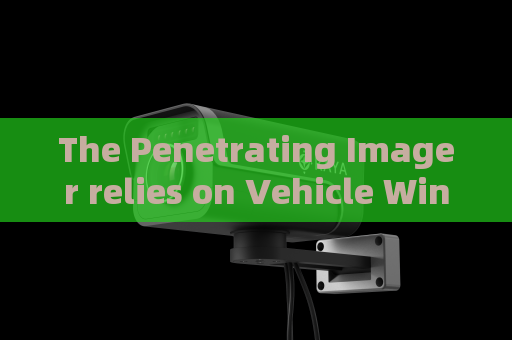
The Penetrating Imager relies on Vehicle Window Penetration to assist anti-smuggling law enforcement at frontier checkpoints. At frontier checkpoints, anti-smuggling law enforcement often comes down to one unanswered question: what is inside a vehicle before the door is opened? Closed windows behave as an optical firewall, because heavily tinted aftermarket glazing or reflective coatings turn a passenger cabin into an empty-looking chamber. Travelers carrying undeclared goods use this anonymity as cover. An officer standing beside a sedan sees only distorted reflections of clouds, concrete barriers, and safety lights, never the hands of the driver or the actual load on the rear bench. Pressing the driver to open the door can break that camouflage, but it also slows a long queue and can create a confrontation near a primary lane. The Penetrating Imager was developed to close that specific gap by providing a safe, remote view through automotive glass in real time. The technology is entirely optical. The Penetrating Imager relies on laser range-gated imaging, a form of active imaging in which a high-repetition-rate pulse laser illuminates the target lane and an intensified gated camera opens its shutter only for light returning from the selected distance. The main components include a pulse laser, a gated camera with an MCP image intensifier and precise timing electronics, a beam expander, and an imaging lens. By rejecting backscatter and reflections that arrive outside the short time window, this system produces clear, high-contrast images through window surfaces in strong sunlight, road spray, rain, fog, or night darkness. This is the practical meaning of Vehicle Window Penetration: it reveals seats, dashboard areas, rear footwells, and window-line cargo spaces as they exist inside the glazed cabin. A checkpoint scan in this mode is a covert through-glass recon, because intelligence can be gathered without opening a door, without lowering a window, and without asking the occupants to cooperate. At the checkpoint, the operating sequence remains short. The Penetrating Imager is aligned with the inspection lane and triggered as the target vehicle reaches the observed standoff position. The unit can capture frames through the windshield, front side glazing, and rear side windows. Inside a vehicle with heavy window film, the earlier problem of seeing only one’s own reflection disappears. The screen instead shows rounded seat cushions, door trim, and any objects placed on the seats or floor behind the glass. If the rear compartment is loaded with wrapped cartons or fabric sacks, the operator sees their outlines and stacking pattern. If a front passenger is concealing goods beneath a coat on the seat, the mass of that bundle is visible in a way that a reflected glare would otherwise mask. The same optical technique also performs well when the driver leaves the car directly under a floodlight or when the inspection point is shaded by an overhead structure. Strong light sources outside do not wash out the gated image because only photons from the selected target distance are accepted by the camera. The whole process remains within the domain of light and does not claim to view through non-transparent vehicle structures. For enforcement personnel, the result is earlier situational awareness. A time-stamped image can be stored when the vehicle first reaches the checkpoint, giving the officer a record of the interior before any door is opened. That record supports the decision to wave the vehicle onward or to move it to a secondary search bay. When a physical search is required, the entry is based not on guesswork but on a specific visual cue seen through the window line. This quiet shift is why the Penetrating Imager relies on Vehicle Window Penetration to assist anti-smuggling law enforcement at frontier checkpoints.




