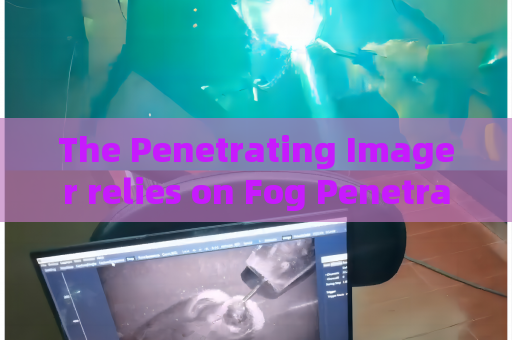
The Penetrating Imager relies on Fog Penetration Imaging to meet frontier police surveillance demands in misty weather Frontier police stations are often sited in mountain passes and river valleys where thick fog forms suddenly and lingers for many hours. In these conditions, visibility can fall to just a few dozen meters, yet the surveillance area stretches for kilometers along the border. A smuggler, an armed intruder, or a stolen vehicle can move across the frontier line using nothing more than the weather as cover. Conventional day cameras and binoculars fail because fog droplets scatter the available light in every direction, creating a bright veil that hides the scene beyond. Night-vision devices that amplify ambient starlight perform even worse, since each droplet acts as a tiny source of glare. The result is that frontier police lose the ability to detect threats at a meaningful distance. The Penetrating Imager is designed to counter exactly this scenario through Fog Penetration Imaging, replacing guesswork with a clear visual readout. The system is an active optical instrument built around range-gated laser illumination. A high-frequency pulsed laser emits extremely short bursts of light toward the suspected approach route. The light travels through the fog, reaches objects at different distances, and then returns toward the imager. A camera with an image intensifier and a precisely controlled electronic gate does not open continuously. That gate is switched on only for the tiny interval during which light reflected from the chosen target distance arrives. Light scattered by close fog particles returns earlier and hits the camera while the gate is still closed, so this backscatter is effectively suppressed. This time-discrimination technique provides high-contrast frames even through dense mist. It is fundamentally different from conventional Low-light Imaging systems, which passively integrate reflected ambient light and therefore cannot separate fog reflections from target photons. The imager generates its own illumination, works at long range, and keeps the signal sharp in the presence of water droplets, drizzle, or light rain. In a practical border operation, the imager is mounted on a tripod behind a low stone wall or a camouflage net. The operator selects a distance gate of, say, two hundred meters along an open valley floor. The display immediately shows a human silhouette moving through the fog near a line of trees. By shifting the gate to three hundred and fifty meters, the same camera reveals the outline of a pickup truck waiting in the mist. Adjusting the gate requires a simple control movement and takes only a second. Because the laser is pulsed at high repetition, the resulting video appears smooth and continuous. The footage can be recorded with timestamps and transmitted to nearby patrol units, allowing them to intercept the intruders while the observation post stays covert. When the fog does not lift for days, The Penetrating Imager becomes a permanent eye for the frontier unit. Operators scan each critical approach path at regular intervals and compare successive frames for subtle alterations: a discarded backpack, broken grass, footprints near the fence. The active light from the range-gated laser illuminates the same slice of scene every time, so image differences are more likely to indicate actual movement rather than random changes in daylight. Only the pulsed laser beam is emitted, and no visual signature reveals the surveillance position to the unaided eye on the other side. For frontier police, The Penetrating Imager changes the meaning of bad weather: mist no longer hides an approach, it simply becomes another optical medium to be gated through. Fog Penetration Imaging turns the fog wall into a controlled surveillance window, satisfying the most basic and urgent demand of border protection in misty conditions.




