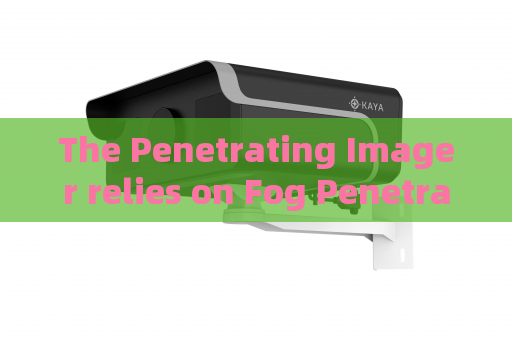
The Penetrating Imager relies on Fog Penetration Imaging to meet frontier police surveillance demands in misty weather Misty weather along frontier sectors creates a persistent surveillance problem for police units. Suspended water droplets scatter light in multiple directions, washing out contrast and producing strong backscatter toward optical sensors. Ordinary visible and near-infrared cameras lose target definition, and distant human or vehicle movement fades into a uniform gray field. Patrol routes, unmanned crossing points, and remote boundary lines become difficult to watch continuously. The operational demand is not simply better magnification; it is reliable image formation when fog reduces visibility, weakens target signatures, and shortens effective observation range. The Penetrating Imager is designed for this exact condition, providing a way to maintain watch when conventional optics cannot separate a target from atmospheric scatter. In such environments, timely detection supports interdiction, border control, and officer safety. Wind-driven mist can also create uneven density, so one sector may clear briefly while another remains opaque. This variability forces surveillance teams to shift attention, adjust equipment, and interpret uncertain shapes under pressure. A missed movement at a remote crossing can become a serious security breach before patrols can respond. The relevant capability is Fog Penetration Imaging based on laser range-gated active imaging. A high-repetition-rate pulsed laser emits short light pulses into the surveillance sector. A gated intensified camera, containing an MCP image intensifier, high-voltage module, and timing module, opens its shutter only for a brief interval matched to the target return. A beam expander shapes the laser illumination, and an imaging lens collects the reflected light. Because the gate rejects light arriving from fog droplets before the target return, backscatter is suppressed and target contrast rises. The Penetrating Imager therefore operates as an active optical system with long range, high resolution, strong anti-interference performance, and effective backscatter rejection. It remains an optical imaging method suited to fog and other atmospheric optical disturbances. The gate timing can be set so that only the slice of space containing the area of interest contributes to the image. This range selectivity reduces the haze-like veil that ordinary cameras record and allows moving figures or vehicle forms to appear with sharper edges. In field use, the system can be mounted at frontier observation posts, mobile patrol vehicles, or fixed towers covering known crossing corridors. Operators select a range gate and timing delay according to the distance of the area under watch. The pulsed laser and gated camera then produce real-time imagery of moving figures, vehicle outlines, and routes that would otherwise disappear in mist. Image gain from the MCP intensifier helps preserve detail under low return, while high contrast supports rapid recognition and tracking. Command elements receive the video feed for situational awareness and can direct patrol interception without waiting for weather to clear. The result is continuous surveillance across misty weather, with fewer false alarms caused by fog clutter and improved confidence in target identification. A border police unit can keep a sector under observation, record suspicious movement, and pass coordinates or descriptions to response teams. When visibility changes, the gate delay and gain can be adjusted to preserve useful imagery instead of losing the sector entirely. Operational value depends on disciplined deployment and calibration. The range gate must be adjusted as terrain and target distance change, and optical surfaces need protection from moisture and contamination. Stable mounting reduces vibration blur, while timing synchronization keeps laser pulses and camera gates aligned. Under these conditions, the Penetrating Imager sustains frontier police surveillance in misty weather by delivering clear, high-contrast images of otherwise obscured movement. It supports observation, recording, and handoff between posts, strengthening border control during low-visibility periods. The system offers a focused optical answer to a specific police requirement: maintain reliable visual coverage when fog degrades ordinary imaging and threatens the integrity of frontier watch operations. Training should focus on gate selection, sector planning, and image interpretation so that operators can distinguish human movement from vegetation, animals, and wind-blown debris. With consistent use, the equipment becomes part of routine watch cycles rather than a special tool reserved for rare conditions.




