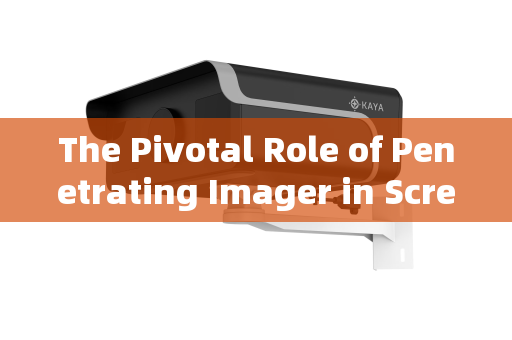
Facial Recognition of People Near Oil Tanks by the Penetration Imager Under Port Light Glare Night Vision Interference with Strong Light Suppression Imaging The security perimeter around oil tank storage zones in busy port environments presents a uniquely challenging surveillance scenario. At night, port lighting—from towering floodlights, cargo vessel deck lamps, and reflective water surfaces—creates extreme glare that overwhelms conventional night vision systems. Standard low-light cameras and thermal imagers suffer from blooming, washout, and dynamic range collapse, rendering the facial features of individuals near the tanks unrecognizable. Simultaneously, the reflective surfaces of vehicle windshields, control room windows, and safety glass on tank monitoring stations introduce optical interference that further degrades image quality. Law enforcement and security personnel tasked with identifying unauthorized personnel or potential threats in these high-value, high-risk zones face a critical gap: they cannot reliably capture facial biometrics under such compounded optical stressors. The problem is not merely about low light—it is about controlled, targeted illumination that can overcome both the blinding glare and the transparent barriers that shield subjects from view. Without a solution, port security remains vulnerable to undetected breaches, sabotage, or theft operations conducted under the cover of visual chaos. The Penetration Imager directly addresses this operational deficiency through its laser range-gated imaging architecture. Unlike passive night vision devices that saturate under bright point sources, the Penetration Imager is an active system that emits high-repetition-rate pulsed laser light and synchronizes the gating of an intensified camera (equipped with MCP, high-voltage module, and timing module) to capture only the light reflected from a specific distance slice. This time-gating mechanism inherently suppresses backscatter from mist, rain, or airborne particulates, but more critically, it rejects the overwhelming ambient glare from port lights because the camera shutter opens only during the brief laser pulse return window. The system’s strong light suppression capability is further enhanced by the high contrast imaging achieved through the narrow bandpass filter matched to the laser wavelength, effectively drowning out the broadband glare from sodium lamps, LED floods, and halogen work lights. For facial recognition near oil tanks, the Penetration Imager can be aimed at a person behind a vehicle windshield or a control room glass panel—the laser pulse penetrates the glass with minimal attenuation, while the gated camera sees through the reflections and glare to deliver a clean, sharp facial image. The system is designed for distant standoff operation, allowing security forces to remain at safe distances from potential hazards like leaking vapors or explosive atmospheres. In practical deployment, a security team positions the Penetration Imager on a tripod or vehicle mount at a vantage point overlooking the tank farm. The operator selects the desired range gate—for example, 50 meters to capture a subject standing between two storage tanks—and adjusts the laser divergence via the beam expander to illuminate only the target area. The imaging lens, combined with the intensified sensor, resolves facial features at distances exceeding 200 meters even under direct port floodlight glare. As the operator observes the real-time video feed, the system automatically suppresses the bright spots caused by nearby lighting masts or reflections from tank surfaces, maintaining facial detail in shadow and highlight regions. The output image can be fed directly into a facial recognition algorithm or displayed on a ruggedized tablet for manual verification. The Penetration Imager’s ability to function through glass is critical here: many of the people near oil tanks are inside vehicles or protective structures—a driver idling near a filling station, a technician inside a glass-walled monitoring booth, or a guard in a cabin. Traditional cameras would capture only a blinding reflection of the port lights on the glass; the Penetration Imager cuts through that reflection, delivering the subject’s face as if the glass were not there. Operational scenarios extend beyond simple identification. During a nighttime security incident, such as a suspicious individual approaching an isolated storage tank, the Penetration Imager can be used to maintain continuous facial surveillance while the subject moves through zones of varying glare—from under a shadow to directly in a floodlight beam. The system’s adaptive gain control within the intensifier prevents the image from washing out when the subject steps into the glare, while the laser range gate ensures the background clutter from distant lights is excluded. For forensic evidence collection, the captured facial images retain sufficient resolution to meet biometric matching standards, even when recorded under dynamic port lighting conditions that change with ship movements and crane operations. This capability transforms a formerly intractable night vision interference problem into a reliable, repeatable facial recognition process, directly enhancing the security posture of critical oil storage infrastructure.




