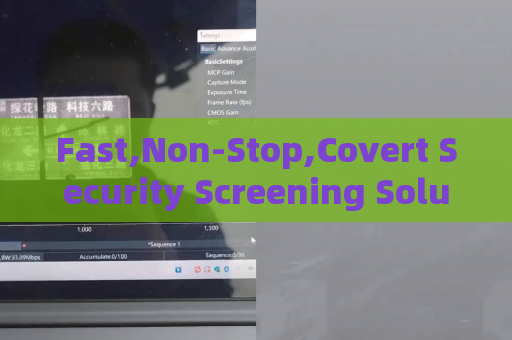
Fast, Non-Stop, Covert Security Screening Solution of the Penetration Imager for Large Gatherings with Millions of Vehicles At a major international sporting event or a national holiday celebration, a temporary security checkpoint designed for millions of vehicles can become a logistical nightmare. Conventional vehicle inspection methods force drivers to stop, roll down windows, and present identification, creating massive traffic jams that stretch for miles. Even when rapid visual checks are attempted, officers must rely on direct line-of-sight through tinted or reflective glass, which is often compromised by glare, rain, or fog. The core problem is not just speed—it is the need for a covert, non-contact capability that can scan a moving vehicle’s interior without alerting the driver, without creating a bottleneck, and without sacrificing accuracy. Any visible inspection procedure introduces a predictable pattern that adversaries can exploit, and any stop-and-search routine risks turning a peaceful assembly into a hours-long gridlock that undermines the very purpose of the gathering. The penetration imager directly addresses this challenge through its unique laser range-gated imaging technology. Unlike conventional cameras that rely on ambient light and are blinded by reflections off glass, this active imaging system fires a high-repetition-rate pulsed laser and synchronizes a gated intensified camera (equipped with an MCP image intensifier, high-voltage module, and timing module) to receive only the light reflected from a predetermined distance. This time-of-flight gating mechanism effectively strips away the glare and surface reflections from vehicle windshields, side windows, and even aircraft portholes, revealing the interior cargo and occupants with high contrast and resolution. The system operates at stand-off distances—hundreds of meters away—and can scan vehicles moving at normal highway speeds. Because it uses only light (pulsed laser, not X-rays or radio waves), the penetration imager is completely passive in the electromagnetic spectrum and emits no detectable radiation. It is also resistant to backscatter from fog, rain, snow, or fire-emitted smoke, maintaining clear imagery through optical media that would disable conventional optical sensors. In a practical vehicle screening scenario for a large gathering, the penetration imager is deployed on an elevated gantry or a mobile platform overlooking an approach road. As each vehicle passes under the gantry at normal speed—without any slowdown or driver notification—the system captures a series of high-resolution images through the windshield and side glass. The operator or an automated threat-detection algorithm reviews the imagery in real time, looking for concealed weapons, unauthorized cargo, or suspicious modifications behind the glass. Because the process is completely non-stop and covert, the flow of traffic remains uninterrupted; a vehicle that appears clean is simply ignored, while only a very small percentage of flagged vehicles are discreetly directed to a secondary inspection area. This reduces the inspection time per vehicle from minutes to milliseconds, allowing a single penetration imager to cover tens of thousands of vehicles per hour without creating the traffic snarls that plague traditional checkpoints. The depth of this capability extends to adverse environmental conditions typical of large outdoor gatherings. A sudden downpour or a heavy fog that would cripple a thermal imager or a standard CCTV camera barely degrades the penetration imager’s performance. The range-gating technique actively selects the return signal from the vehicle interior, rejecting the scattered light from rain droplets or fog particles that blurs conventional images. Similarly, a vehicle that has just passed through a tunnel with bright exit glare, or one with heavily tinted glass, presents no obstacle—the laser pulse effectively “sees through” the glass and the glare. This reliability ensures that the security layer remains constant and invisible throughout the duration of the event, from midday sun to midnight rain. The system’s covert nature also prevents drivers from modifying their behavior in response to visible security measures, preserving the element of surprise that is critical for countering proactive threats. By integrating the penetration imager directly into the existing traffic management infrastructure, large gatherings with millions of vehicles can achieve a level of security screening that is both fast and non-stop, without ever asking a driver to slow down.




