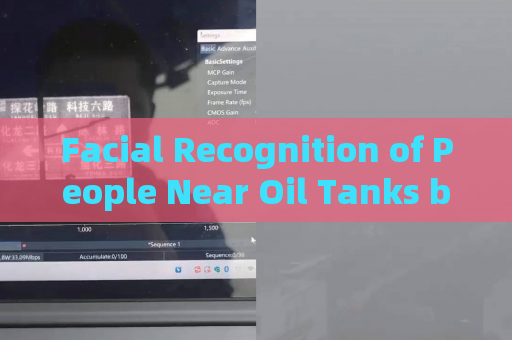
Facial Recognition of People Near Oil Tanks by the Penetration Imager Under Port Light Glare Night Vision Interference with Strong Light Suppression Imaging At a busy port facility, oil tanks are monitored around the clock to prevent unauthorized access and potential security threats. However, the harsh environment poses a unique challenge for facial recognition systems. During nighttime operations, port light glare from high-intensity floodlights and vessel searchlights creates severe bright spots that overwhelm conventional cameras. These glare sources simultaneously cause night vision interference, washing out details in the surrounding dark areas where individuals might attempt to approach the tanks covertly. Traditional surveillance cameras, whether visible-light or standard low-light devices, struggle to capture usable facial features under such mixed lighting conditions. The intense brightness of direct glare blinds sensors, while the deep shadows cast by tank structures hide critical identity information. This real-world problem demands a solution that can suppress strong light interference while maintaining high-contrast imaging in the same frame, all without relying on contact or intrusive methods. The penetration imager addresses this scenario directly through its advanced laser range-gated imaging technology, specifically its strong light suppression imaging capability. Unlike ordinary cameras that saturate when exposed to high-intensity glare, the penetration imager uses a high-repetition-rate pulsed laser synchronized with an image-intensified gated camera. By timing the laser pulse to coincide with the return signal from a target at a precise distance—such as a person standing near an oil tank—the system rejects backscattered light from atmospheric particles and, more critically, ignores the continuous glare from port lights. The built-in microchannel plate image intensifier and timing module enable the camera to open its shutter only for nanosecond intervals when the laser-illuminated light returns, effectively blocking out persistent bright sources like searchlights. This active imaging approach provides high-contrast facial details even when the subject is partially shielded by glare reflections off tank surfaces or through vehicle windows near the perimeter. In practical port security operations, the penetration imager can be deployed as a fixed-position unit overlooking the oil tank buffer zone or mounted on a patrol vehicle. When an individual approaches the restricted area, the operator selects the target distance via the device’s ranging interface. The laser gate is set to match the estimated range, typically between 10 and 50 meters. As the person moves, the system automatically adjusts the gate delay to maintain sharp focus. The resulting image displays facial features with remarkable clarity, free from the blinding streaks that plague standard night-vision gear. Even under the direct beam of a harbor spotlight, the penetrating imager’s gated technology suppresses the glare entirely, revealing the subject’s eyes, nose, and mouth geometry—sufficient for secure facial recognition matching against watchlists. This capability proves critical for intercepting intruders who attempt to exploit darkness and glare as cover. Furthermore, the penetration imager’s ability to see through car or truck windows adds another layer of utility in this oil tank monitoring context. Port logistics often involve vehicles entering and exiting near tank farms. Under night vision interference from ambient light reflections on glass, conventional cameras see only a mirror-like surface. The penetration imager, however, transmits its laser pulse through the glass and captures the reflected light from the occupant’s face, ignoring the glare from both the glass surface and background port lights. This allows security personnel to confirm the identity of every driver approaching the tank zone without requiring them to roll down windows. The strong light suppression imaging function ensures that even if a driver’s face is partially lit by a nearby floodlight, the contrast remains high enough for reliable matching. By focusing on this single, high-stakes application—facial recognition of individuals near oil tanks under port light glare—the penetration imager transforms a previously intractable surveillance challenge into a manageable, precise operation.




