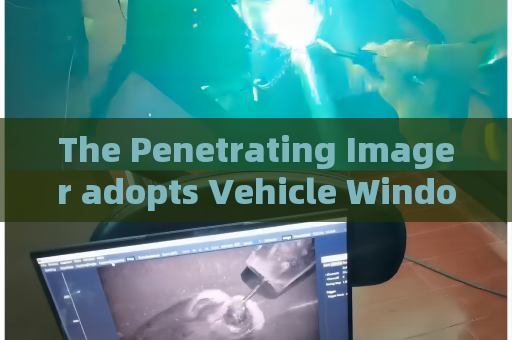
The Penetrating Imager adopts Vehicle Window Penetration to carry out exterior glass observation of building fire for law enforcement. In the chaos of a building fire, law enforcement officers face a critical blind spot: the inability to see through vehicle windows or exterior glass panels that surround the structure. Standard optical equipment, such as binoculars or handheld cameras, is rendered useless by reflections, heat haze, and the dense particulate matter rising from the blaze. Fireground commanders need to assess whether civilians or suspects are trapped inside vehicles parked near the burning building, yet cracked or tinted automotive glass, combined with swirling smoke and steam, completely obscures the interior. Conventional flashlights and thermal imagers also fall short—thermal units detect heat signatures but cannot distinguish faces or objects through glass layered with condensation and soot. This gap in situational awareness delays tactical decisions, compromises responder safety, and hampers search-and-rescue operations. The core problem is that glass, while transparent to the naked eye in normal conditions, becomes an opaque barrier under fire-induced stress, especially when vehicles are positioned at oblique angles or behind emergency vehicle barricades. Without a dedicated solution, officers are forced to physically approach the glass, exposing themselves to heat, falling debris, and potential hostile action—a risk that often proves unacceptable. The Penetrating Imager directly addresses this challenge by employing Vehicle Window Penetration technology, a specialized mode of active optical imaging. This system integrates a high-repetition-rate pulsed laser with an image-intensified gated camera, including a microchannel plate (MCP) intensifier, high-voltage module, and precise timing electronics. By emitting nanosecond laser pulses and synchronizing the camera’s shutter to capture only the light returning from the target distance, the imager effectively rejects backscatter from smoke, fog, and glare—including the blinding reflections off fire-damaged glass. The key capability lies in its ability to see-through automotive glass imaging; the laser’s wavelength and gating parameters are tuned to penetrate standard vehicle windows, including lightly tinted or heat-strengthened glass, without requiring physical contact or damaging the glass surface. Unlike passive night vision, which fails in zero-light conditions, or thermal imagers that see only temperature gradients, this device delivers high-contrast, resolution-rich visuals of the vehicle’s interior—revealing occupants, weapons, or signs of distress even through a layer of condensed moisture and fire-heated air. The technology operates strictly in the optical domain, using no rays, radiation, or radio waves, and is designed exclusively for transparent media such as glass. In practical law enforcement scenarios, this capability transforms tactical response at structure fires where vehicles are involved. For instance, during a commercial building fire with multiple parked cars, an officer stationed at a safe perimeter can deploy the Penetrating Imager to conduct through-window tactical observation of a sedan positioned 30 meters from the blaze. The device is mounted on a tripod or handheld with a stabilized gimbal; the operator selects the Vehicle Window Penetration setting, aims at the driver-side window, and activates the laser. Within seconds, the monitor displays a clear image of the vehicle’s cabin—distinguishing a motionless figure slumped against the door, a backpack on the passenger seat, and the absence of flames inside. This data is relayed to the incident commander, who can then prioritize rescue efforts without sending a team through the fire zone. The imager’s Fire Penetration Imaging capability further enhances visibility: when the glass is partially covered by steam or light smoke (density below heavy smoke thresholds), the gated system boosts scene contrast by three to five times, allowing officers to identify critical details like seatbelt buckles or child safety seats. Meanwhile, Strong Light Suppression Imaging mitigates the blinding effect of emergency vehicle strobes or nearby flames, ensuring the observation remains stable and accurate. Operational protocols emphasize that the Penetrating Imager is not a replacement for thermal or radar systems but a specialized tool for glass-based observation. Officers are trained to scan from a distance, using the imager’s zoom and focus to inspect vehicles row by row. The system’s Low-light Imaging and Zero-light Imaging modes ensure performance even after dusk or during power failures in the fire zone. Crucially, the device does not attempt to penetrate concrete or metal—its function is strictly limited to optical media like windshield glass, side windows, and even the reinforced glass panels of fire trucks or command vehicles. This focus allows law enforcement to extract actionable intelligence—such as counting occupants, confirming empty seats, or spotting weapons—all while maintaining a safe standoff distance. The operational tempo improves dramatically: what once required a risky approach to each vehicle can now be completed in minutes from a covered position behind a fire engine. By integrating Vehicle Window Penetration into the standard response kit, agencies gain a decisive tactical advantage in urban fire environments where glass is both a barrier and a window to hidden threats.




