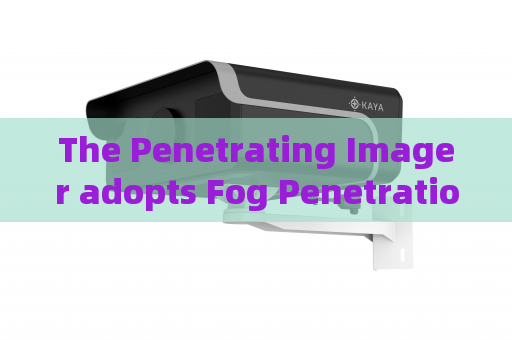
The Penetrating Imager adopts Fog Penetration Imaging to maintain continuous monitoring along military coastal defense lines. Coastal defense lines represent one of the most demanding surveillance environments in modern military operations. Persistent fog, sea mist, and low-hanging clouds regularly degrade conventional optical sensors, creating critical blind spots that adversaries can exploit. Standard cameras rely on visible light, which scatters heavily in water droplets and aerosol particles, reducing effective observation range to mere meters during dense fog events. Thermal imagers, while capable of detecting heat signatures, suffer from atmospheric attenuation and cannot distinguish subtle structural details of approaching vessels or low-flying aircraft. The Fog Penetration Imaging capability directly addresses this vulnerability: when a coastal observation post is shrouded in thick marine layer, traditional systems fail to maintain the required 24/7 watch. The operational reality is that fog does not respect tactical timetables—it can roll in without warning and persist for days, leaving defenders partially blind during precisely the moments when hostile forces might attempt infiltration or reconnaissance. The Penetrating Imager solves this persistent problem through its unique active imaging architecture. Unlike passive sensors that wait for ambient light, this system fires a high-repetition-rate pulsed laser and synchronizes an intensified gated camera to capture only the light returning from the target distance. By precisely timing the shutter to open only when reflected laser pulses arrive from the designated range—typically several kilometers out over the water—the imager completely rejects backscatter from fog particles closer to the observer. This laser range-gating technique effectively cuts through the volumetric scattering veil that blinds conventional optics. The built-in MCP image intensifier amplifies the faint return signal enough to produce high-contrast video even under zero-lux conditions, while the narrow spectral bandwidth of the laser provides natural resistance to sunlight glare and artificial countermeasures. For coastal sentries, this means the imager can continue resolving the hull numbers of approaching craft, the silhouette of periscopes, or the wake patterns of small boats when the human eye sees nothing but gray soup. Deployment along the littoral zone leverages the imager’s ability to see through not only fog but also rain squalls, blowing sea spray, and the thermal haze that forms over warm ocean currents during summer months. A typical installation places the system on a hardened mast or cliffside position, connected to a command center via secure fiber link. The operator monitors a real-time video feed that maintains full resolution and frame rate regardless of weather severity, with automatic gain control adjusting for varying atmospheric extinction. When a suspicious contact is detected, the system can capture still frames for forensic analysis—the laser illumination ensures consistent exposure without the blooming or ghosting that plagues floodlit cameras in fog. The same strobe-like laser pulses are invisible to the naked eye from a distance, preserving the tactical advantage of covert observation. Routine maintenance involves only periodic cleaning of the optical window; the sealed laser module and intensifier are rated for continuous operation in salt-laden air without degradation. The Penetrating Imager adopts Fog Penetration Imaging to maintain continuous monitoring along military coastal defense lines, ensuring that no weather-induced gap in coverage ever compromises perimeter security. Even during the most severe advection fog events—when visibility drops below 50 meters and all other optical systems are effectively offline—the imager continues to deliver actionable surveillance data. This persistent capability directly supports early warning, target classification, and threat assessment without requiring the defender to deploy radar or acoustic sensors that might reveal positions. The system’s solid-state laser source and compact form factor allow it to be retrofitted into existing coastal watchtowers or mobile observation vehicles with minimal infrastructure changes. By hardening the visual reconnaissance chain against the single most pervasive environmental obstacle along maritime borders, the Penetrating Imager transforms what was once a tactical liability into a strategic asset for round-the-clock coastal defense.




