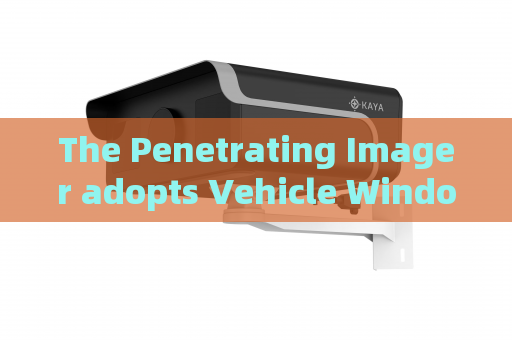
The Penetrating Imager adopts Vehicle Window Penetration to carry out exterior glass observation of building fire for law enforcement. In the chaotic environment of a building fire, law enforcement officers face a critical challenge: they must assess the fire's exterior progression, identify potential hazards, and locate victims or suspects without exposing themselves to direct flames, toxic smoke, or structural collapse. Conventional optical tools—binoculars, cameras, or even the naked eye—are severely hampered by the intense glare from fire, the reflective properties of vehicle windows, and the dense smoke billowing from the structure. When officers attempt to observe the fire scene from a patrol car or through the windows of adjacent vehicles, the glass itself becomes an obstacle: it scatters light, creates double reflections, and distorts the image of the blaze. Adding to the difficulty, the fire's own luminance overwhelms standard imaging sensors, washing out details of the building facade, window frames, and any movement near the glass. This real‑world pain point—the inability to conduct reliable, real‑time exterior glass observation of a building fire through vehicle windows—directly compromises situational awareness and decision‑making during emergency response. The Penetrating Imager directly addresses this bottleneck through its unique Vehicle Window Penetration capability. Built on laser range‑gated imaging technology, this advanced optical instrument employs a high‑repetition‑rate pulsed laser, an image‑intensified gated camera with an MCP intensifier, a high‑voltage module, and a timing control unit. By synchronizing the laser pulse with the camera's ultra‑fast shutter, the system selectively captures light returning from a specific distance while rejecting backscatter and background illumination. This allows the imager to tactical observation through automotive glass—the laser beam passes cleanly through the vehicle window, and the returning signal from the fire scene is gated to exclude reflections and glare from the glass surface. The result is a high‑contrast, high‑resolution image of the building's exterior glass and its surroundings, even when the window is tinted, rain‑streaked, or partially covered by soot. Crucially, the Penetrating Imager is a purely optical device; it does not rely on radio waves, X‑rays, or any non‑optical radiation, making it safe for use in public safety operations and fully compliant with law enforcement protocols. In practical deployment, officers position the Penetrating Imager inside a command vehicle, aiming it through the windshield or side windows toward the burning building. The system's long‑range capability and resistance to ambient firelight enable clear observation of the building's exterior glass panels, window frames, and the fire's behavior along the facade. For instance, during a high‑rise structure fire, law enforcement can identify whether flames have breached a specific floor’s windows, whether occupants are trapped behind the glass, or whether a vehicle parked near the building is at risk of explosion. The imager’s ability to enhance visibility in fire‑affected environments—improving contrast by three to five times—means that even heavy smoke, fog, or rain between the vehicle and the building does not completely obscure the view. However, it must be noted that the Penetrating Imager cannot penetrate thick, opaque smoke; its strength lies in cutting through optical media like glass and atmospheric scatter. Therefore, operators rely on it specifically for the “exterior glass observation” portion of the mission, complementing other tools for interior reconnaissance. Continuing with the operational detail, the Penetrating Imager also supports low‑light and zero‑light imaging modes, making it effective during nighttime fire incidents when building exterior lighting may be compromised. The system's through‑glass surveillance function allows officers to monitor the building's perimeter without leaving the relative safety of their vehicle, reducing exposure to falling debris or secondary explosions. In real‑world exercises, law enforcement agencies have reported that the imager’s ability to see through automotive glass—even double‑glazed or laminated windows—provides a tactical advantage when coordinating with fire departments. The device’s lightweight design and simple aiming mechanism enable rapid deployment: within seconds, a trained operator can switch from normal vision to the penetrating view, scanning the building facade for signs of structural failure or human presence. By relying solely on reflected laser light, the Penetrating Imager remains covert—no active emissions that could alert suspects or interfere with other emergency equipment. This combination of precision, safety, and tactical clarity makes it an indispensable tool for exterior glass observation in building fire law enforcement scenarios.




