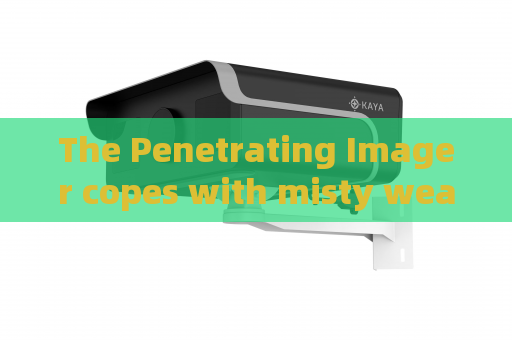
The Penetrating Imager copes with misty weather surveillance demands with Fog Penetration Imaging for frontier law enforcement. Frontier law enforcement faces a persistent and critical challenge: maintaining continuous visual surveillance in regions where mist, fog, and low-hanging clouds are frequent. Along remote border lines, these meteorological conditions can reduce visibility to mere meters, rendering conventional optical systems—binoculars, spotting scopes, and standard CCTV cameras—virtually useless. The inability to see through fog compromises early threat detection, allowing unauthorized crossings, smuggling operations, or hostile movements to go unnoticed until it is too late. Traditional thermal imagers, while helpful in darkness, struggle with fog because water droplets scatter infrared radiation, producing only blurred heat signatures. The real pain point is not just the loss of image clarity, but the resultant gap in situational awareness that leaves border patrol units blind during the very weather conditions when incursions are most likely to occur. The Penetrating Imager directly addresses this operational vulnerability. The Penetrating Imager solves this problem through its Fog Penetration Imaging capability, built on laser range-gated imaging technology. Unlike passive optical devices that rely on ambient light or thermal contrast, this active imaging system emits high-repetition-rate laser pulses and synchronizes a gated intensified camera to capture only the light reflected from a specific distance. This time-gating mechanism effectively rejects backscatter caused by fog particles, which would otherwise flood the sensor with scattered light. The result is a sharp, high-contrast image of targets at ranges far beyond what standard cameras can achieve in misty conditions. The system combines a pulsed laser, an image intensifier with microchannel plate, and precision timing modules to achieve centimeter-level range resolution. By illuminating the scene with controlled laser energy and gating out the fog’s interference, the Penetrating Imager delivers actionable intelligence where other optics fail. In frontier law enforcement operations, the practical application of this technology transforms fog from a tactical liability into a neutralized condition. Deployed at border observation posts, the Penetrating Imager can be mounted on tripods or vehicle platforms to scan known crossing points and trails during fog events. Operators view real-time imagery on a ruggedized display, identifying individuals, vehicles, or contraband loads at distances up to several hundred meters through dense mist. The system’s active illumination also provides Low-light Imaging and Zero-light Imaging capability, ensuring around-the-clock surveillance regardless of ambient light. For instance, during a patrol shift at dawn in a mountainous border sector, officers using the Penetrating Imager can detect a person attempting to cross through thick fog that has reduced visual range to 50 meters—while the imager still resolves the subject clearly at 300 meters. The gating depth can be adjusted to focus on either foreground or background, allowing operators to scan layered terrain without re-aiming. This operational simplicity, combined with built-in Strong Light Suppression Imaging to counter vehicle headlights or flashlights, makes the system a reliable tool for sustained frontier security. The impact of Fog Penetration Imaging on frontier law enforcement extends beyond mere visibility. By eliminating fog as a cover for illicit activity, the Penetrating Imager forces adversaries to operate under constant observation, shifting the tactical advantage back to border security forces. The technology also reduces the need for risky physical patrols in poor weather, lowering officer exposure to hazards while increasing detection rates. Maintenance is straightforward: the all-weather housing and sealed optics withstand the humidity and temperature swings typical of border environments. Operators train quickly on the intuitive interface, and the system’s ability to see through vehicle windows and tinted glass adds another layer of utility for checkpoint inspections. In sum, the Penetrating Imager with Fog Penetration Imaging closes a critical capability gap, ensuring that misty weather no longer equals blind spots on the frontier.




