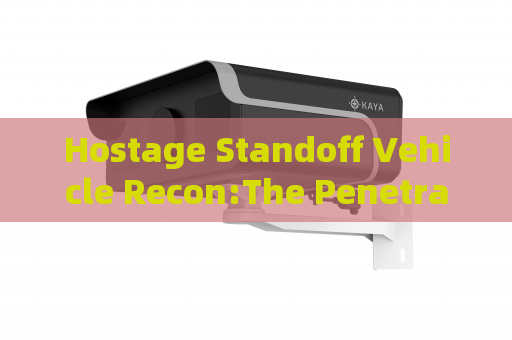
Hostage Standoff Vehicle Recon: The Penetrating Imager uses Through-glass Imaging Technology for safe external observation
In a hostage standoff scenario, the vehicle becomes a fortified stronghold. Law enforcement faces a critical dilemma: how to assess the threat inside without compromising tactical safety or alerting the suspect. Conventional external observation through automotive glass is notoriously unreliable. Tinted windows, dirty surfaces, glare from sunlight or streetlights, and even slight movements of the vehicle can render visual reconnaissance useless. Officers forced to approach for a closer look risk exposing themselves to hostile fire. Thermal imagers struggle with glass reflection and often fail to distinguish individuals from seats or other heat sources inside a cabin. The fundamental pain point is the absence of a non‑contact, covert method to see through vehicle glazing with high clarity and from a safe standoff distance.
This gap is directly addressed by the Penetrating Imager, which employs Through‑glass Imaging Technology to enable safe external observation. The system is an active optical imager based on laser range‑gated imaging—a technique where a pulsed laser illuminates a target, and an intensified camera captures the returning light only from a selected depth slice. By precisely timing the camera’s shutter to match the round‑trip time of light reflected from objects behind the glass, the device effectively rejects the bright backscatter from the window surface itself. The result is a clear, high‑contrast image of the vehicle’s interior, unobscured by reflections, dirt, or moderate tinting. Unlike passive systems, it works in broad daylight, low light, or even zero‑light conditions because the laser provides its own illumination. The through‑window tactical observation capability gives operators the power to count subjects, identify weapons, and monitor movements—all from a concealed position 50 to 150 meters away.
In operational use, the Penetrating Imager is deployed from a tactical vehicle or a tripod within a protected perimeter. A single officer operates the unit, aligning the laser and camera assembly toward the target vehicle’s side window or windshield. The system’s range‑gated control is adjusted until the interior scene appears crisp on the display. Because the laser pulse is invisible to the naked eye and operates at eye‑safe power levels, there is no risk of detection or harm to anyone inside. The imager also includes Strong Light Suppression Imaging to handle scenarios where the suspect directs a flashlight or high‑beam headlights outward; the gate timing can be shifted to avoid saturating the sensor. Real‑time video feed is transmitted to the command post, allowing decision‑makers to formulate an entry plan based on accurate, up‑to‑date intelligence. The entire process remains covert—no sound, no visible light signature, and no required physical approach to the vehicle.
The tactical value of this technology becomes even clearer when considering specific hostage‑barricade dynamics. A suspect may be holding a victim against a seat, hiding below the dashboard, or positioning a weapon at an angle only visible from outside. Traditional binoculars or spotter scopes cannot penetrate heavy aftermarket tint that blocks over 90% of visible light. The Penetrating Imager’s glass‑penetrating imaging overcomes this by relying on near‑infrared laser wavelengths that pass through most automotive glazing with minimal attenuation. Even when rain, fog, or smoke from nearby incendiary devices degrades visibility, the range‑gated technique filters out intervening scatter, maintaining a sharp view of the cabin. This capability transforms the standoff vehicle from an opaque threat into a transparent environment, enabling negotiators and tactical teams to coordinate with precision—without ever breaching the suspect’s awareness. The Penetrating Imager remains the single most effective tool for safe external observation in vehicle‑based hostage situations, delivering high‑fidelity intel from a distance that keeps every officer out of harm’s way.




