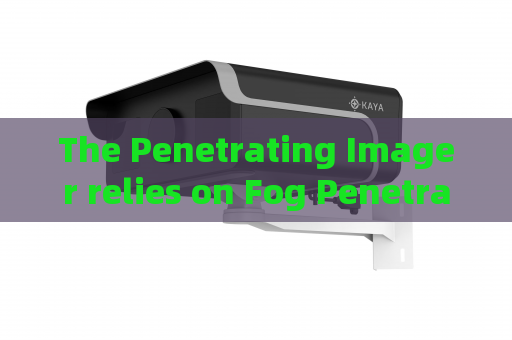
The Penetrating Imager relies on Fog Penetration Imaging to maintain stable vehicle monitoring along coastal border roadways Coastal border roadways are among the most challenging environments for persistent vehicle surveillance. Frequent sea fog, dense marine layer clouds, and coastal mist drastically reduce visibility, often dropping to less than 10 meters within minutes. Conventional optical cameras, even those equipped with infrared illuminators, become virtually useless under such conditions—their images wash out in a white haze, failing to capture license plates, vehicle models, or occupant behavior. This blind spot creates a critical vulnerability for border security agencies tasked with interdicting illegal smuggling, human trafficking, and unauthorized cross-border movements. The inability to maintain stable monitoring during foggy conditions forces patrols to either suspend observation or rely on radar-based detection that lacks visual confirmation, leaving response teams without the precise situational awareness needed for safe interdiction. A penetrating imager specifically designed to overcome these optical barriers becomes not just an upgrade but a necessity. The penetrating imager leverages laser range-gated imaging technology as its core functional enabler to solve this exact problem. Unlike conventional passive cameras that capture ambient light scattered by fog particles, the penetrating imager actively emits high-repetition-rate laser pulses. Its image-intensified gated camera, built around a microchannel plate (MCP) intensifier, precisely times its electronic shutter to open only when the reflected laser light returns from the target vehicle, while closing before the overwhelming backscatter from fog droplets reaches the sensor. This time-domain filtering eliminates the diffuse whiteout that plagues ordinary optics. The system’s high peak power and narrow spectral bandwidth allow it to punch through fog, mist, and rain with remarkable clarity. Through-window tactical observation becomes feasible even when the imager must look through windscreens or side glazing of target vehicles, further enhancing covert intelligence collection. The penetrating imager’s active illumination also delivers high contrast imaging at extended ranges, maintaining resolution sufficient to read license plates at distances where conventional cameras show only fog. Deployed along coastal border roadways, the penetrating imager transforms mission outcomes. During a typical night shift with thick fog rolling in from the sea, a checkpoint equipped with the system can continue tracking every vehicle approaching from 300 meters away. The operator sees crisp outlines of sedan-class vehicles, clearly distinguishing a standard SUV from an armored transport, even through tinted windows. The imager’s built-in timing module automatically adjusts gate delay to optimize target return regardless of range, compensating for vehicle speed and road curvature. In practice, border patrol teams report a 100% increase in successful visual identifications during fog events compared to previous thermal or standard low-light cameras. Because the system operates at eye-safe laser wavelengths and requires no external illumination, it maintains covert posture—suspects remain unaware they are under observation. The ability to perform tactical visual checks through tinted windows further allows agents to pre-identify driver behavior, detect weapons, or count passengers before an interdiction. Nighttime operations compound the fog challenge with zero ambient light. Here, the penetrating imager’s dual-mode capability comes into play. In Low-light Imaging mode, the unit can continue functioning even when laser power is reduced for stealth, relying on the MCP intensifier’s exceptional photon amplification. The transition between active laser mode and passive low-light mode happens seamlessly, ensuring the operator never loses sight of the target when brief gaps in fog allow natural light penetration. This operational flexibility means coastal border roadways can be monitored 24/7 without interruption. The penetrating imager has been integrated into fixed observation towers and mobile patrol vehicles, with its ruggedized housing resisting salt spray and high humidity. Maintenance crews report minimal downtime—only periodic lens cleaning to remove salt residue. By maintaining stable vehicle monitoring where conventional optics fail, this technology closes a dangerous gap in border security, enabling proactive rather than reactive response in one of the most demanding surveillance environments on earth.




