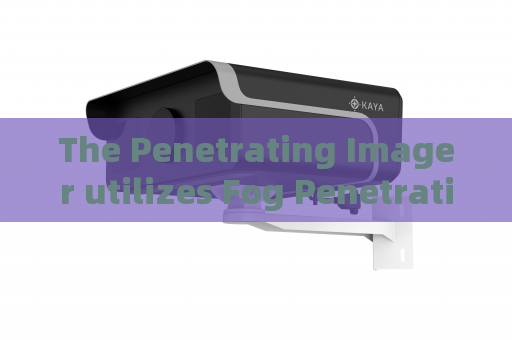
The Penetrating Imager utilizes Fog Penetration Imaging to maintain clear vehicle observation in misty border patrol zones. In the vast, often remote border regions, fog is a persistent adversary. Patrol officers rely on visual confirmation to identify approaching vehicles, assess threats, and monitor cross-border traffic. When dense fog rolls in, visibility can drop to a few meters, turning routine observation into a guessing game. Standard optical systems—binoculars, cameras, and even thermal imagers—struggle. Fog particles scatter visible light, creating a white wall that obscures details like license plates, driver behavior, or cargo outlines. This optical interference delays threat detection and increases the risk of surprise incursions. The challenge is not just seeing vehicles, but seeing them clearly enough to make split-second decisions in a high-stakes environment. Without a reliable solution, officers are forced to rely on sound or closer approach, both of which compromise safety and response time. The need for a tool that cuts through the fog without revealing the observer’s position is acute. The through-window tactical observation capability of The Penetrating Imager directly targets this problem. Unlike passive optical devices, this system is an active imaging instrument built on laser range-gated imaging technology. It consists of a high-repetition-rate pulsed laser, an intensified gated camera with an MCP image intensifier, a high-voltage module, a timing module, a beam expander, and an imaging lens. The key mechanism is temporal gating: the laser emits a short pulse of light, and the camera shutter opens only when the reflected signal from the target—at a precisely known distance—returns. This eliminates nearly all backscatter from fog particles between the imager and the vehicle. The result is a clean, high-contrast image through mist that would otherwise be completely opaque. Because the system relies on light, not radio waves or acoustic signals, it remains covert: no emissions betray the observer’s location. The Penetrating Imager is specifically engineered to overcome optical media interference—including fog, rain, snow, and even fire smoke in moderate conditions—making it an ideal tool for border patrol units operating in persistently misty zones. In practice, the effect is transformative. During a typical border patrol operation in heavy fog, a standard camera might register only a vague shape. The Penetrating Imager, by contrast, delivers crisp imagery at distances exceeding standard visual ranges. Officers can identify vehicle models, read license plates, and observe occupant movements from a safe standoff position. The system’s high resolution and strong anti-interference capabilities ensure that even tinted automotive glass or dirty windshields do not degrade the image. Operation is straightforward: the patrol officer aims the imager at the target area, adjusts the range gate to match the estimated distance, and views the real-time output on a display. No complex calibration or special training is required. The unit is compact enough for vehicle mounting or handheld use, and its active imaging works equally well in low-light or zero-light conditions, extending its utility into night operations when fog often lingers. This reliability reduces the need for dangerous close approaches and allows continuous monitoring of border checkpoints and remote trails. The operational impact extends beyond mere visibility. In a misty border patrol zone, every second of uncertainty can escalate a situation. With The Penetrating Imager, officers gain the ability to maintain clear vehicle observation without revealing their own position. The laser illumination is invisible to the human eye and to most night vision devices, preserving the tactical advantage of stealth. Furthermore, the system’s ability to suppress strong light—such as oncoming headlights—prevents glare from ruining the image. This combination of fog penetration and low-light performance means that patrols can maintain situational awareness even when weather conditions are at their worst. The device does not replace other sensors; it fills a critical gap where optical clarity is lost and thermal imaging fails to penetrate moisture-laden air. By providing a reliable visual feed in a scenario that historically forced blind reliance on instinct, The Penetrating Imager becomes a force multiplier for border security operations in fog-prone regions.




