Coastal fog presents a persistent and severe challenge for reconnaissance operations. In such environments, conventional optical systems—binoculars, telescopic sights, and standard surveillance cameras—suffer catastrophic performance degradation. Water droplets suspended in the air scatter visible light indiscriminately, creating a bright veil of backscatter that washes out target contrast. Operators scanning for suspicious vessels, illegal fishing activity, or unauthorized shoreline crossings find their field of view reduced to a few meters of gray nothingness. Thermal imagers, while less affected by fog, fail to differentiate objects at the same temperature as the background, such as a boat hull against cold seawater. The operational tempo slows to a crawl, and the advantage of standoff observation is lost entirely. This pain point is acute for coastal patrol units, maritime law enforcement, and border security agencies that must maintain situational awareness in low-visibility conditions. The need for a device that can see through the fog—not just into its edges—has long been an unfulfilled requirement in tactical reconnaissance.
The Penetrating Imager solves this problem through its core Fog Penetration Imaging capability. Built on laser range-gated imaging technology, the system synchronizes a high-repetition-rate pulsed laser with an intensified gated camera. The laser emits a short, powerful pulse of near-infrared light toward the target area. The camera shutter remains closed until the precise moment when the reflected signal from the intended target returns, blocking the overwhelming backscatter from fog droplets closer to the system. This gating mechanism effectively slices through the fog, capturing only the light that has traveled to the target depth and back. The result is a high-contrast, high-resolution image of objects that are optically invisible to the naked eye. Unlike passive devices that rely on ambient light or thermal signatures, this active imaging approach delivers clear visuals in the densest coastal fog. The Penetrating Imager’s components—an MCP-based image intensifier, a high-voltage module, and precise timing electronics—work together to suppress the diffuse glow of fog while preserving sharp edges and fine details of vessels, structures, or personnel.
In field application, the device enables operators to conduct through-window tactical observation from safe distances. A patrol vessel can remain offshore while the operator scans the coastline through a fog bank that reduces visibility to under 50 meters. The Penetrating Imager, mounted on a tripod or stabilized platform, transmits real-time imagery to a command display. The range-gate is adjusted to match the estimated distance of the target—whether a boat moored at a pier or a person moving along the shore. The operator sees the target with clarity comparable to a clear-day view, while the system’s active illumination remains invisible to the naked eye due to the use of near-infrared wavelength. This covert aspect is critical for tactical recce, as the subject remains unaware of the surveillance. The device also excels in low-light conditions that often accompany foggy coastal mornings; the laser itself provides sufficient energy for Low-light Imaging, eliminating the need for floodlights that would betray the operator’s position.
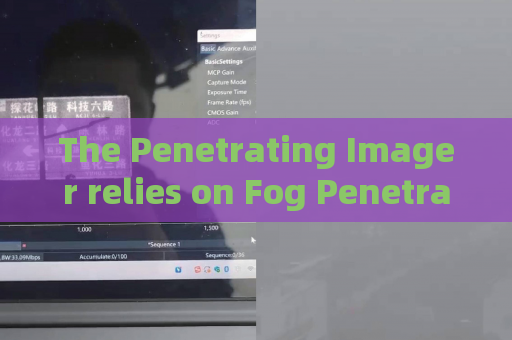
The operational workflow in a foggy coastal scenario is straightforward. After power-up, the system self-calibrates its timing module based on the ambient range. The operator selects the desired standoff distance and fine-tunes the gate width to isolate a single plane of interest. As the fog density fluctuates, the automatic gain control adjusts the intensifier sensitivity to maintain consistent image quality. For moving targets, the high frame rate of the gated camera eliminates motion blur. When observing through the spray and mist near the surf line, the Fog Penetration Imaging mechanism remains stable, rejecting the random scattering from droplets. The result is a steady, usable feed that allows the operator to identify vessel registration numbers, count personnel, or spot concealed cargo. This capability transforms a previously blind operational environment into a reliably observable one, giving coastal reconnaissance units a decisive tactical advantage without requiring any modification to existing patrol protocols or deployment patterns.




