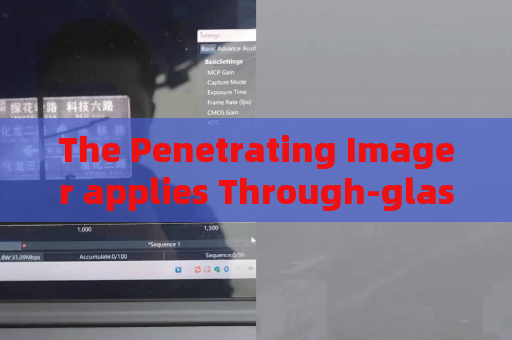
The Penetrating Imager applies Through-glass Imaging Technology to monitor suspect vehicles in military blockade areas. In military blockade zones, the ability to assess threat level inside a stopped or slow-moving vehicle is often compromised by the very materials designed to protect occupants. Tinted windows, reflective coatings, privacy glass, and even simple dirt or condensation turn a standard optical inspection into a guessing game. A suspect vehicle may conceal armed individuals, explosives, or contraband, but the blockade officer has no reliable means to confirm what lies behind the windscreen without exposing personnel to potential ambush. The core problem is not a lack of surveillance equipment—it is the fundamental optical barrier posed by automotive glass, which scatters, absorbs, and reflects visible light, rendering conventional cameras and binoculars useless for see-through inspection at safe standoff distances. The Penetrating Imager solves this dilemma through active laser gated imaging, a technique that exploits the time-of-flight of short laser pulses to isolate the reflection from a target layer while rejecting backscatter from the glass surface. The system comprises a high-repetition-rate pulsed laser, an intensified gated camera with an MCP image intensifier, and synchronized timing modules. By firing nanosecond laser pulses and opening the camera shutter only when light returning from the vehicle interior arrives, the imager effectively “slices through” the windshield glass. This method—known as Vehicle Window Penetration—enables the operator to obtain a high-contrast, high-resolution image of the cabin without any physical contact or emission of detectable signals. Because the technology relies entirely on controlled light pulses, it operates purely within the optical domain, offering a covert and non-radiating solution suitable for sensitive military checkpoints. In practice, the Penetrating Imager is deployed at a distance of 30 to 150 meters from the suspect vehicle, well beyond small-arms engagement range. The operator positions the tripod-mounted unit, selects the appropriate gate delay to match the interior depth, and observes the real-time image on a ruggedized tablet. Under typical daylight conditions, the system can clearly reveal the number of occupants, the presence of weapons on seats or in door panels, and even subtle movements such as reaching for a hidden item. Night operations are equally effective due to the Low-light Imaging capability of the intensified sensor, which amplifies the reflected laser light without relying on ambient illumination. The imaging process is silent and invisible to the naked eye—the laser operates outside the visible spectrum—ensuring that the suspect remains unaware of the through-window tactical observation being conducted. This tactical advantage allows blockade commanders to make informed decisions, such as escalating the response or ordering a controlled extraction, without risking a sudden hostile reaction. For maximum operational flexibility, the Penetrating Imager also compensates for adverse weather and obscurants frequently encountered in military environments. Fog, light rain, dust, and even smoke from nearby burning vehicles degrade standard optics, but the gated imaging principle rejects most of the scattered light from these particles, maintaining a clear view of the vehicle interior. Fire Penetration Imaging mode, which increases visibility in flash-fire scenarios by a factor of three to five, further extends usability when blockades are established near combusted debris. Importantly, the system cannot see through solid barriers such as metal body panels or concrete—it is strictly limited to optical media like automotive glazing, aircraft windows, and glass building facades. This precise boundary prevents false expectations and ensures that intelligence gathered through the Penetrating Imager is always interpreted within the correct physical context. The result is a reliable, single-purpose tool that transforms the most uncertain moment in a military blockade—the look inside a dark-windowed vehicle—into a data-rich, low-risk observation.




