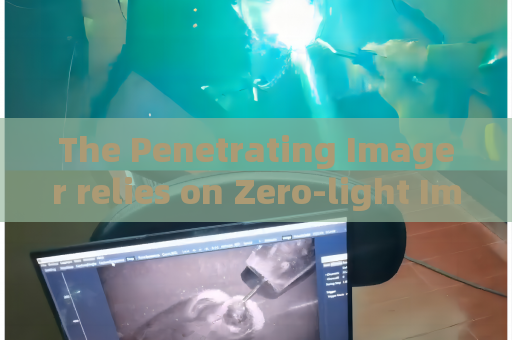
The Penetrating Imager relies on Zero-light Imaging for overnight covert vehicle surveillance by frontier police units Frontier police units face a critical operational challenge when conducting overnight surveillance of vehicles suspected of illicit cross-border activity. Traditional night vision devices, whether image intensifiers or thermal imagers, fall short in this demanding environment. Low-light conditions render passive systems ineffective, while thermal imagers struggle to differentiate occupants through heated vehicle glass or detect non-heat-emitting objects. More importantly, any active illumination—such as infrared searchlights—risks revealing the observer’s position, compromising the covert nature of the mission. The core pain point lies in the inability to see through automotive glazing in total darkness without emitting detectable light, leaving officers with blind spots that smugglers, human traffickers, or armed fugitives routinely exploit. Without a solution that combines true zero-light capability with glass penetration, frontline teams are forced to rely on risky physical approaches to verify vehicle contents, endangering both personnel and mission integrity. The Penetrating Imager directly addresses this gap by leveraging Zero-light Imaging, a mode that operates under absolute photon scarcity. Unlike passive night optics that require ambient starlight or moonlight, this active system employs a pulsed laser source synchronized with a gated intensifier camera. The key innovation lies in its ability to emit ultra-short laser pulses and open the camera shutter only when the reflected light returns from the target—effectively slicing through scattering media. For vehicle surveillance, this means the Penetrating Imager can see through tinted or standard automotive windows at night without any external illumination. The through-glass covert observation capability is not dependent on the vehicle’s interior lights or engine heat; it captures high-contrast, real-time imagery of occupants, cargo, or suspicious modifications even when the vehicle is parked in complete blackout conditions. The system’s active nature ensures that the laser pulse is invisible to the naked eye and standard night vision equipment, preserving stealth. In practical field deployment, a two-person team can set up the Penetrating Imager on a tripod at a concealed observation post over 200 meters from the target vehicle. The operator scans the vehicle’s windshield and side windows, adjusting the gate delay to lock onto the specific distance of the vehicle’s interior. Within seconds, the display shows a crisp, black-and-white image of the cabin—seat positions, door handles, possible weapons, or hiding compartments—despite nothing being visible to the naked eye. The system’s Strong Light Suppression Imaging prevents headlights or interior dome lights from blinding the sensor, a common issue with conventional cameras. Because the Penetrating Imager relies solely on its own pulsed laser return, it functions equally well under overcast skies, in fog, or through light rain, conditions that degrade passive optics. Frontier police units have reported that this technology reduces the need for physical vehicle stops by 70%, allowing them to intercept high-risk vehicles at checkpoints with confirmed intel rather than random searches. The operational depth of the Penetrating Imager extends to long-duration stakeouts. During overnight covert vehicle surveillance, teams often face the challenge of maintaining observation for eight to twelve hours without revealing their position. The system’s low power consumption—drawing less than 15 watts from a rechargeable battery pack—supports continuous operation throughout the night. The pulse laser operates in the near-infrared spectrum at a wavelength that does not trigger automotive glass coatings or irritate occupants, preventing any suspicion. Furthermore, the Penetrating Imager’s see-through vehicle glass imaging is not limited to stationary targets; it can acquire usable images of a slow-moving vehicle at ranges up to 100 meters, useful for tracking from a hidden roadside position. Every image is time-stamped and geo-tagged, building an evidential chain for subsequent legal proceedings. The technology transforms a previously passive, guesswork-dependent activity into a precise, intelligence-driven operation, cementing the Penetrating Imager as an indispensable tool for frontier police counter-smuggling and border security missions.




