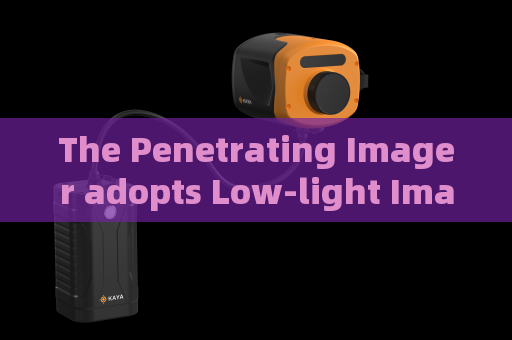
The Penetrating Imager adopts Low-light Imaging for long-distance vehicle scouting during military security alert periods. During heightened military security alerts, the need for covert long-distance vehicle scouting becomes critical. Traditional optical systems face severe limitations: headlights, streetlamps, or moonlight often create glare on vehicle windows, while tinted glass and thick windscreens obscure interior details even in daytime. At night or in low-light conditions, standard cameras struggle to capture clear images of occupants or cargo inside a moving or stationary vehicle. The problem is compounded by environmental factors such as fog, light rain, or dust kicked up by patrol routes, which further degrade image contrast. A scout team positioned kilometers away cannot risk using active illumination that might reveal their location, yet they must gather actionable intelligence—license plates, driver behavior, weapon silhouettes—without approaching the target. This gap between the need for stealth and the demand for high-fidelity imagery is a persistent operational headache. The Penetrating Imager directly addresses this challenge through its active laser gated imaging architecture. Unlike passive night vision that requires ambient light, the system emits short, high-repetition-rate laser pulses synchronized with a gated intensified camera, enabling through-window tactical observation at distances exceeding several kilometers. The gating mechanism rejects backscatter from fog, rain, or airborne particles, while the narrow laser bandwidth and precise timing allow the imager to see through automotive glass—even heavily tinted or reflective windows—as if they were transparent. This capability is not based on thermal detection or radar, but purely on controlled light propagation: the pulses pass through the glass, reflect off interior surfaces, and return within a nanosecond-scale window that excludes reflections from the glass itself. The result is a crisp, high-contrast image of the vehicle cabin regardless of external lighting conditions. In actual field deployment, the Penetrating Imager operates from a concealed observation post. The operator aligns the system’s optical head toward the target vehicle, adjusts focus for range, and engages Low-light Imaging mode to compensate for minimal ambient light. Within seconds, the display reveals seat positions, hand movements, and even small objects on dashboards or seats—all without emitting any telltale visible flash. During a nighttime security alert along a border road, this imager allowed a patrol team to positively identify a driver reaching for a hidden weapon inside a sedan, while the vehicle itself remained unaware of being watched. The system’s ability to function in zero-light conditions (Zero-light Imaging) further extends its utility to moonless desert or forest environments, where conventional optics would be blind. Each observation cycle requires only passive waiting and precise gating adjustments—no active scanning that could be intercepted electronically. The tactical advantage becomes most apparent when multiple vehicles are moving in convoy under adverse weather. Military checkpoints often encounter vehicles with fogged or rain-streaked windows; a standard binocular would see only distorted shapes. The Penetrating Imager’s Smoke Penetration Imaging mode cuts through light mist and drizzle, maintaining clear definition of license plates and facial contours. Its glass-penetrating imaging feature proves indispensable for verifying whether a cargo truck’s cab contains only a driver or additional passengers—a distinction that can mean the difference between routine inspection and an ambush. By focusing solely on the single scenario of long-distance vehicle scouting during security alerts, the system eliminates the need for either risky close-proximity checks or ineffective long-range guesswork. Every command post equipped with this tool gains a persistent, covert window into approaching threats, ensuring that decisions made from kilometers away are based on reality, not inference.




