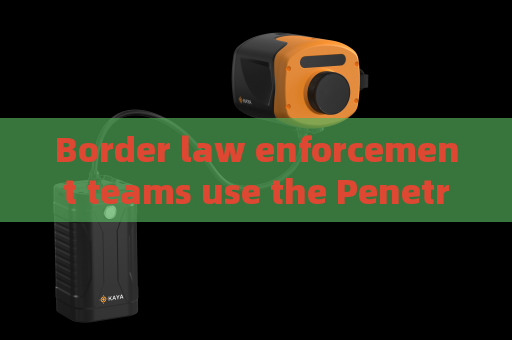
Border law enforcement teams use the Penetrating Imager to break visual barriers of heavily tinted car windows. Heavily tinted automotive glass is a routine obstacle at border checkpoints. A vehicle approaching the inspection lane may appear completely opaque from the outside, its occupants and cargo hidden behind a dark film that defeats standard optical scrutiny. Law enforcement officers face a genuine dilemma: opening the door or requesting the driver to lower a window introduces tactical risk, especially when intelligence suggests smuggling, human trafficking, or armed escape. Visible light reflected off the vehicle surface is overwhelmed by the dark glazing, while ambient illumination inside the cabin remains too low for the human eye or conventional cameras to resolve. The problem is not merely visual inconvenience. It is a security gap that can conceal weapons, contraband, or persons in distress, turning a routine stop into a potentially lethal encounter. Without a means to see through the glass from a distance, officers must choose between escalating contact or allowing a vehicle to pass without adequate inspection. The Penetrating Imager is an active optical imaging system built on laser range-gated imaging technology. It consists of a high-repetition pulsed laser, an image-intensified gated camera with an MCP image intensifier, a high-voltage module, a timing module, a beam expander, and an imaging lens. Unlike passive cameras that depend on ambient light, the Penetrating Imager emits short laser pulses and synchronizes the camera gate to receive only the light reflected from the target plane at a precise distance. This range-gating principle rejects most of the backscattered light generated by the intervening medium, which in this scenario is the heavily tinted car window. The system’s ability to perform through-window tactical observation stems from its selective gating: it effectively ignores the confusing reflections and scattering produced by the glass surface, capturing a high-contrast image of what lies beyond. The operational result is a clear, real-time visual of the vehicle interior, even when the window film absorbs or reflects a large portion of ordinary light. The imaging is purely optical, using no rays other than light itself, and does not involve any form of penetrating radiation that could pass through solid walls or other non-transparent materials. In practice, an officer positions the Penetrating Imager at a safe standoff distance from the suspect vehicle, aiming the instrument at the driver-side or passenger-side window. The operator adjusts the gate delay to match the distance to the target seat plane, then observes the displayed image. The pulsed laser illuminates the cabin through the glass, and the gated camera collects the returning photons only from the chosen depth. This allows the team to detect whether the driver’s hands are visible on the steering wheel, whether a rear passenger is crouching low, or whether a package lies on the seat. The system works in daylight and at night, and its strong light suppression capability prevents glare from headlights or overhead lamps from washing out the image. Because the technology actively generates its own illumination, it performs reliably in low-light and even zero-light conditions, though the core scenario remains the tinted automotive glass barrier. Officers can conduct the visual check without alerting the occupants, as the laser pulse is not perceptible through the dark film, enabling a covert assessment before any direct contact. The tactical advantage extends to high-risk encounters at border crossings, where vehicle windows may be tinted beyond legal limits or reinforced with non-standard films. The Penetrating Imager converts an opaque surface into a transparent surveillance plane, giving officers the crucial seconds needed to evaluate threats before opening the door. In a case involving a suspected concealed compartment behind the rear seat, the imager can peer through the side glazing to reveal anomalies such as altered upholstery or a suspicious silhouette. Its resistance to backscatter proves especially valuable when the window is dirty, scratched, or partially covered with water droplets. The same gated imaging principle that rejects heavy tint reflections also enables operation through smoke, fog, rain, and snow, although the immediate application remains vehicle glass inspection. By maintaining a non-contact, purely optical approach, the Penetrating Imager restores visual transparency where tinted glass once created a blind spot, strengthening the observational capability of border law enforcement teams without compromising their safety.




