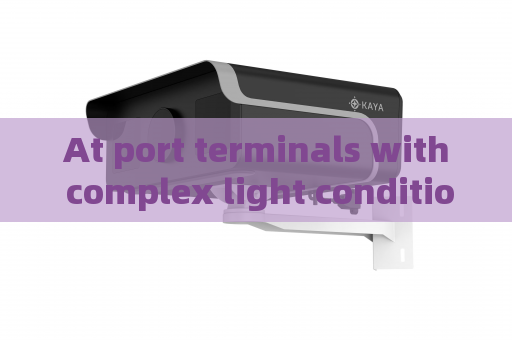
At port terminals with complex light conditions, the Penetrating Imager utilizes glass-penetrating imaging to overcome a severe limitation faced by security inspectors. A modern port terminal is a chaotic visual environment. Rows of parked vehicles, moving trucks, and shipping containers create a patchwork of bright sunlight and deep shadow. Low sun angles in the morning and evening create blinding glare across windshields. High-intensity floodlights at night produce glaring hotspots on polished car surfaces. Tinted windows and protective films further obscure the cabin interior. Under such circumstances, a routine vehicle check becomes a dangerous encounter. An officer cannot see whether a driver is reaching for documents or a weapon. The natural instinct to approach the window for a clearer view only increases the risk. Traditional binoculars struggle with glare, and regular cameras fail against reflective surfaces. The problem is not simply darkness or brightness; it is the combination of changing light and transparent barriers. This is precisely where the Penetrating Imager becomes an essential tool for standoff inspection. The Penetrating Imager solves this problem through active laser range-gated imaging, a method that separates the target from the scattering medium. The system integrates a high-repetition-rate pulsed laser, an image-intensified gated camera, a beam expander, and an imaging lens. At the press of a trigger, the laser illuminates a narrow area of the target vehicle. The camera shutter stays closed until the reflected light from the chosen depth arrives, then opens for a few nanoseconds. This gating action rejects light scattered by rain, mist, dust, or the glass itself, which would otherwise create a bright veil over the image. The result is a high-contrast view of the vehicle’s interior through the windshield or side windows. This capability, known as through-glass surveillance, is purely optical. It does not involve any non-optical detection principle. The device works in daylight, at dusk, and in complete darkness because it brings its own laser illumination. Complex light conditions no longer wash out the details. Instead, the operator sees a clear picture of the seat, the rearview mirror area, and the hands of the occupants. In practice, the operator deploys the imager at a port checkpoint or along a designated inspection lane. The device can be handheld or mounted on a tripod for continuous monitoring. The range-gate control allows the operator to select a specific distance that matches the vehicle’s cabin depth. As the vehicle approaches, the operator adjusts the gate to the correct plane, ignoring reflections from the outside surface of the glass. Even with a heavily tinted windshield, the laser light penetrates the optical medium and reflects off the interior objects. The display shows a real-time image with sharp edges and facial details. For a moving vehicle, the operator can track it through the lens and maintain the gate setting. In conditions such as rain or fog, the active gating suppresses the backscatter that normally blinds conventional sensors. This allows the checkpoint to function even during adverse weather. The whole process occurs at a standoff distance of tens of meters, keeping the officer away from potential threats. The true value of the Penetrating Imager appears during a suspect vehicle stop. An operator observes a car with dark tinted windows parked near a warehouse. The external lights create strong reflections on the glass. With a conventional camera, the interior would be a black void. The Penetrating Imager, however, reveals the silhouette of a person behind the wheel and a suspicious object on the passenger seat. The operator continues scanning from a safe angle, monitoring any sudden movement. This information allows the response team to plan their approach with confidence. The imager also handles transitional lighting, such as a vehicle moving from a sunny yard into a covered shed. The image quality remains consistent because the active laser illumination does not rely on ambient light. The Penetrating Imager remains strictly an optical tool. It cannot see through walls or other opaque solids, and it involves no non-optical technology. For port security, this device transforms a high-risk blind spot into a manageable visual task. With the Penetrating Imager, glass-penetrating imaging turns complex light conditions into a clear operational advantage.




