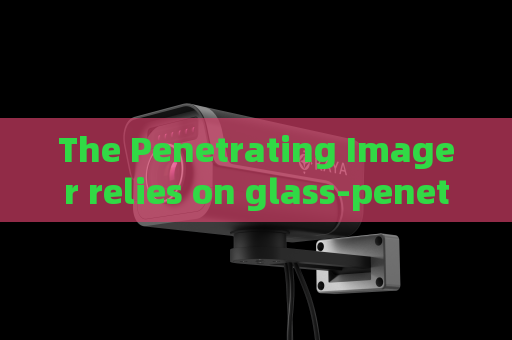
The Penetrating Imager relies on glass-penetrating imaging to screen suspicious vehicles near military restricted zones. Near military restricted zones, the approach of any unknown vehicle presents a serious security challenge. A stationary car on a shoulder, a slow-moving sedan, or a delivery van that lingers near the perimeter can all be seen, but not understood. The interior of a vehicle is normally hidden behind layers of optical obstruction. Tinted windows reduce visible light to a fraction of its original intensity. Reflective coatings turn the windshield into a mirror that throws sunlight or headlight glare back into the observer's eyes. In darkness, the problem deepens because the driver and passengers disappear into a black cavity. Conventional surveillance cameras and binoculars cannot overcome these conditions. They capture the exterior paint, the license plate, and the silhouette of the car, but they cannot reveal what is happening inside. That missing information is precisely what a security team needs when deciding whether to stop the vehicle or let it pass. The Penetrating Imager addresses this gap by relying on glass-penetrating imaging to screen suspicious vehicles near military restricted zones. The Penetrating Imager is an active optical imaging system. Its core components include a high-repetition pulsed laser, an intensified gated camera with an internal microchannel plate image intensifier, a high-voltage module, a timing module, a beam expander, and an imaging objective. The camera shutter stays closed until light reflected from the chosen distance returns, which blocks the overwhelming backscatter from the glass surface and airborne particles. This range-gated technique creates a high-contrast image of objects at a precise plane inside the vehicle cabin. The system is designed to work only with optical media. It sees through automotive glass, railway windows, aircraft portholes, and glass curtain walls. It cannot penetrate masonry, concrete, metal, wood, or clothing, and it never relies on anything other than light. That makes through-glass covert observation feasible at a distance where a suspect vehicle has not yet reached the checkpoint. The imager can even suppress strong light interference from direct sunlight or oncoming headlights, preserving detail on the occupants’ hands and faces. In a typical deployment, the imager is placed on a stable mount behind a low wall or inside a sheltered position overlooking the access road. The operator selects the distance to the targeted car using the timing module and adjusts the laser illuminator and camera focus accordingly. Once the target enters the field of view, the system starts producing real-time images of the vehicle interior without the driver becoming aware of the observation. The gated camera can distinguish between the reflection from the outer surface of the glass and the relatively delayed light returning from seats, dashboards, and occupants. Even when the vehicle is moving at moderate speed, the image remains clear enough to identify a hand reaching under a seat or a person in the rear compartment attempting to hide. The system operates effectively in low-light and zero-light conditions, using its own pulsed laser for illumination rather than revealing the position with a visible beam. Rain, fog, snow, and haze cause less degradation than they would for a passive optical system because the narrow range gate rejects most of the scattered light. The decisive value appears in the final approach before a vehicle reaches the gate. Security personnel can watch the driver's hands, the behavior of passengers, and the outline of cargo through the windshield and side windows. A large object on the floor in the back seat becomes visible, prompting a redirect to the inspection bay. A driver who is not looking at the road but repeatedly checking a phone or a document under the dashboard alerts the team to unusual intent. The Penetrating Imager gives this information from a safe standoff distance, without requiring an officer to walk up and peer through the window. It can be used continuously at a fixed checkpoint or moved to a temporary observation point along an approach route. Every vehicle that passes the line is screened with the same high-contrast, through-glass view. The Penetrating Imager relies on glass-penetrating imaging to screen suspicious vehicles near military restricted zones, and this capability transforms a blind spot into one of the most reliable layers of perimeter security.




