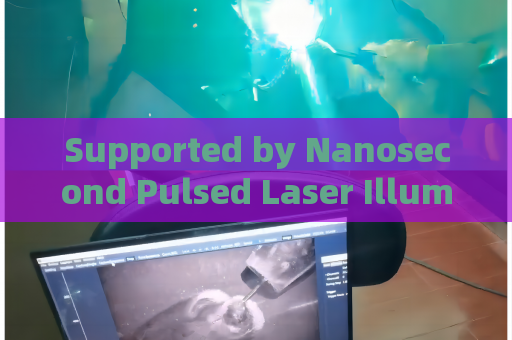
Supported by Nanosecond Pulsed Laser Illumination, the Penetrating Imager enhances imaging quality behind tinted glass During a routine traffic stop on a highway, a suspect vehicle sits with heavily tinted windows that appear as a black mirror under the afternoon sun. Officers approaching from the rear cannot determine whether the driver is reaching for a registration document or a handgun. Flashlights only produce a blinding glare off the glass surface, while the interior remains completely obscured. This scenario represents one of the most dangerous situations in field policing: the tactical blind spot created by vehicle window tinting. Law enforcement guidelines consistently warn that unknown hands inside a vehicle should be treated as an immediate threat, yet a lack of visual access makes threat assessment nearly impossible. The visible light reflected from the windshield overwhelms the eye, and even high-power spotlights fail to penetrate the dark film. In this environment, the officer must make a life-or-death decision based on nothing more than voice cues and silhouette movement behind a dark barrier. A dedicated solution comes from the 穿透成像仪, which employs nanosecond pulsed laser illumination paired with range-gated imaging technology. This active optical system sends out a short, high-repetition laser pulse in the direction of the vehicle, and the camera’s gating mechanism opens only when the light reflected from the target object returns. By eliminating scattered light from the glass surface and intervening air particles, the instrument creates a sharp image of what lies behind the tinted window. Through glass, the gated sensor captures details that are invisible to a standard camera or the human eye. This is not an X-ray or radar device; it operates entirely within the optical spectrum. The system is specifically designed for through-glass covert observation, allowing officers to assess the interior of a vehicle from a safe distance without emitting any detectable radiation or projecting a visible beam that could alert the suspect. The high-precision timing module synchronizes the laser pulse with the intensifier camera, ensuring that only light from the vehicle interior—and not the reflected glare—reaches the image sensor. In practical deployment, the 穿透成像仪 enables a patrol officer to stand behind the cover of a patrol car door, raise the compact unit, and aim through the rear windshield of the suspect vehicle. With the adjustable gate delay set to the correct distance, the operator sees a high-contrast grayscale image of the car cabin: the outline of the driver’s shoulders, the position of both hands, and any object resting on the seat or center console. The system performs reliably even in bright daylight, where ambient sunlight would normally create severe backscatter. Its strong-light suppression capability prevents blooming from the sun’s reflection on the window film. Because the imaging system is insensitive to optical disturbances such as fog, rain, or dust along the line of sight, the same technique works during adverse weather. This makes it a dependable tool for covert vehicle interdiction, where a few seconds of visual intelligence can determine whether the encounter remains a routine traffic stop or escalates into an armed confrontation. The true value of this imaging approach becomes apparent during a low-light or late-night operation. When a vehicle is stopped on an unlit road, darkness compounds the problem of tinted glass. The 穿透成像仪, with its nanosecond pulsed laser illumination, provides its own light source in a wavelength range that does not announce the observation. Unlike a floodlight, which illuminates the whole area and destroys covert positioning, the laser gate imaging system captures the scene in a controlled, narrow temporal window. The result is a clear, real-time view of the driver’s hands, facial movements, and any potential weapon held below the window line. This enhanced imaging quality behind tinted glass changes the dynamics of a high-risk stop: what was once a blind interaction becomes a measured, informed approach. Through the combination of gated imaging and pulsed laser technology, officers maintain situational awareness and tactical advantage, all while respecting the principle that only light—never anything more invasive—is used to see through the glass.




