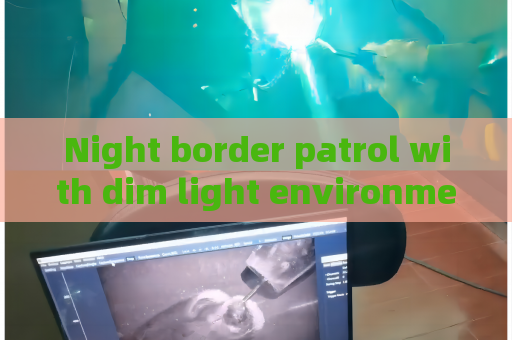
Night border patrol with dim light environment, Penetrating Imager relies on Zero-light Imaging to realize full-time monitoring The border at night presents one of the most demanding environments for surveillance operators. In the absence of moonlight or starlight, the terrain dissolves into a featureless black expanse, while vehicle headlights, concealed movements, and tinted windows become nearly impossible to resolve with conventional optics. A patrol team scanning a remote crossing must contend with extreme low-light conditions, where a subject behind a car windshield is effectively invisible. The real pain point is not simply darkness—it is the combination of darkness and optical barriers. A person can hide inside a vehicle, observing the patrol while remaining unseen. Traditional night vision devices amplify ambient light, but they fail when the target is behind glass, and they are blinded by any sudden strong light source. The need for a system that sees through the darkness and through the glazing simultaneously is critical for border security. The Penetrating Imager addresses this specific challenge with a laser range-gated active imaging approach. Instead of relying on ambient photons, the instrument emits short high-repetition pulses from a high-power pulsed laser, synchronizing an image-intensified gated camera to receive only the light reflected from the target plane. This gating mechanism rejects backscatter from fog, rain, or atmospheric particles, and crucially, it allows the imager to see through automotive glass, aircraft windows, and glass facades. In a dim border environment, the device operates in Zero-light Imaging mode, meaning it does not need any external illumination source. The system captures clear, high-contrast imagery of a subject sitting inside a vehicle, even when the interior is unlit. The operator sees the silhouette, facial features, and hand movements in real time, without alerting the subject to the observation. On a moonless night along a remote border segment, a patrol vehicle halts at a checkpoint where a suspicious sedan approaches. The operator aims the Penetrating Imager through the windshield from a distance of tens of meters. The device’s gated camera opens only for the precise time window corresponding to the target distance, ignoring the reflective glare of the windshield and the darkness beyond. The displayed image reveals the driver’s posture, a passenger reaching toward the floorboard, and the outline of a concealed object—all rendered with enough detail to make an immediate tactical decision. Because the imaging system uses light rather than any other form of radiation, it remains a purely optical surveillance tool, safe for repeated use on civilians and compatible with existing binoculars and spotting scopes. The operation continues without interruption through the night. When a second vehicle arrives with heavily tinted rear windows, the Penetrating Imager still yields a usable image of the rear compartment, thanks to its ability to suppress strong reflections and its resilience to extremely low ambient light. The border patrol team maintains continuous monitoring without ever turning on a searchlight that would reveal their position. The technology closes the gap between total darkness and transparent observation, turning a previously blind spot into a well-lit visual channel. For the patrol officer standing in the dark, the penetrating view through glass is not a feature—it is the difference between reacting to a threat and stopping it before it emerges.




