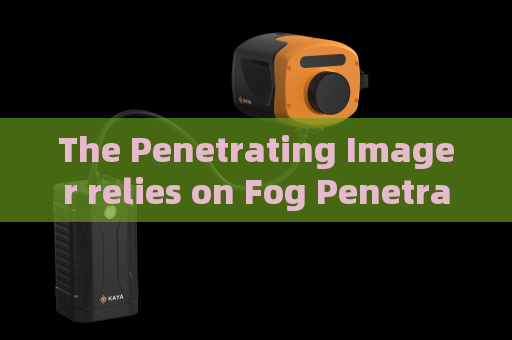
Dense sea fog along coastlines creates a severe operational blind spot for reconnaissance units. The mixture of cold ocean currents and humid air produces a thick aerosol layer that can persist for hours. Natural light is diffused by countless microdroplets, turning routine patrols into guesswork. A small boat or a person moving along the shore becomes indistinguishable from the grey background. Even experienced observers lose depth perception and range estimation. Traditional optical devices, including standard night vision and daylight cameras, fail under such low-contrast conditions because they rely on ambient light or simple image intensification. The urgent need is a tool that can see through the fog layer without relying on non-optical detection methods. The Penetrating Imager is designed to address this exact vulnerability by using Fog Penetration Imaging. The Penetrating Imager is an active optical system built around a high-repetition-rate pulsed laser and an intensified gated camera with a microchannel plate image intensifier. Its laser emits short pulses toward the target area. The camera shutter opens after a precisely calculated delay, matching the time that light takes to travel to the target and back. This range-gating process rejects most of the light scattered by fog droplets along the path, because that scattered light arrives earlier or later than the targeted return. Unlike passive sensors that collect all reflected light at once, the gated camera only records photons returning from a thin slice of space. The result is a clear image of the object itself, not the bright fog in front of it. This capability directly overcomes the primary cause of poor visibility in coastal fog, enabling Fog Penetration Imaging over practical distances. The system includes a beam expander to illuminate a wide field, and the imaging lens captures the chosen plane with high resolution. With each laser pulse, the backscattered noise is suppressed, while the useful signal stands out. During an actual coastal patrol using Fog Penetration Imaging, an operator sets up the imager on a tripod and scans the harbor entrance. The gate delay is adjusted step by step to focus on different water ranges. At 500 meters, a fishing boat that was invisible to the naked eye appears with sharp outlines on the screen. The imager also functions well in Low-light Imaging mode, which extends its usefulness from overcast afternoons into dusk and early night. The operator can hold a fixed position and monitor a narrow channel continuously, while the system’s strong light suppression prevents glare from lighthouse lamps or searchlights from washing out the image. Each frame provides enough contrast to distinguish a person from a buoy or a hull from floating debris. The display shows a monochrome picture with clear edges, allowing the operator to count the number of individuals on deck or verify whether a suspected vessel carries cargo. A zoom function on the imaging lens brings distant details into view without moving the tripod. When the fog thins, the operator adjusts the range-gating window to maintain coverage at the selected distance. The true measure of the Penetrating Imager in foggy coastal areas is not just the ability to detect a target, but to maintain surveillance over time. As the tide changes, the fog may drift in bands. A single operator can re-adjust the gate delay to match the new optical path, keeping the target locked. The system’s high range resolution allows separate images of objects only a few meters apart, which is critical for breaking through the visual clutter of breaking waves and mist. For reconnaissance teams working along a foggy shoreline, the Penetrating Imager relies on Fog Penetration Imaging to turn an opaque white wall into a transparent window. This capability changes the entire dynamics of coastal security operations. A patrol craft can stay offshore while the imager, mounted on a mast, maps a landing zone through thick fog. Commanders receive real-time data on target movement without exposing personnel to close-range encounters. The same optical principle also protects the operator’s eyes because the laser is limited to short pulses and safe wavelengths. The unit serves as a reliable eye for coastal units when every other sensor is blinded by the weather.




