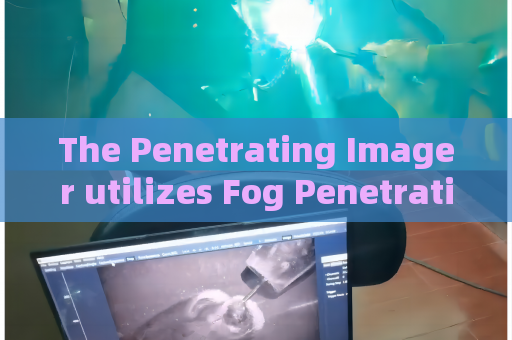
The Penetrating Imager utilizes Fog Penetration Imaging to maintain clear vehicle observation in misty border patrol zones Misty border patrol zones present a recurring nightmare for surveillance personnel. Fog does not merely reduce visibility; it transforms the entire environment into a shifting white curtain that absorbs light, distorts shapes, and annihilates depth perception. A patrol vehicle waiting at a checkpoint can vanish from view at thirty meters. Suspicious cars approaching through the mist may be invisible until they are almost on top of the officers, leaving no time to assess intentions or spot hidden weapons. Conventional optical aids, including night-vision devices that rely on ambient light, suffer catastrophic degradation because each water droplet scatters the incoming photons back toward the source. The result is a blinding veil of backscatter that makes through-glass surveillance impossible. In this high-stakes setting, the inability to see through fog is more than an inconvenience; it is an operational blind spot that smugglers and hostile actors exploit with impunity. The Penetrating Imager has emerged as a purpose-built answer to this specific border patrol pain point. The Penetrating Imager utilizes Fog Penetration Imaging to maintain clear vehicle observation in misty border patrol zones. This is achieved through laser range-gated imaging, an active optical technique where a high-repetition pulsed laser illuminates the target and a gated camera opens its shutter only for the precise time window when the reflected pulse returns from the vehicle. Any light scattered by fog particles arrives earlier or later than the target return and is therefore excluded by the timing gate. This process eliminates the dominant source of image degradation in mist: backscatter from atmospheric aerosols. The instrument consists of a high-repetition pulsed laser, an image-intensified gated camera with a microchannel plate, high-voltage and timing modules, a beam expander, and an imaging lens. Because the system generates its own illumination, it operates with equal effectiveness in daylight, twilight, or complete darkness. This active illumination gives the Penetrating Imager an inherent advantage over passive optics. The range gate can be adjusted to focus on a specific distance, allowing officers to select a vehicle among multiple lanes and ignore fog layers that lie between the imager and that vehicle. Through-window tactical observation of the target is thus possible even when the entire patrol zone is enveloped in thick mist. Operating the device at a foggy border checkpoint follows a direct and repeatable procedure. The officer scans the road with the imager’s wide field of view and adjusts the Penetrating Imager's range-gate control to set the focal plane at the suspected distance of an approaching car. For a target at 150 meters, the gate is tuned to receive light that has traveled exactly 300 meters round trip. The resulting image shows the vehicle’s silhouette, roof lines, and windshield details with remarkable clarity, free from the fog haze that obscures the naked eye. If the vehicle is moving, the operator tracks it smoothly by adjusting the gate range in small increments, maintaining focus on the car’s body and its windows. This capability enables officers to see whether a driver is holding a phone, reaching for a document, or displaying signs of nervousness long before the car reaches the stop line. The imager’s high contrast and resolution also reveal the presence of passengers in the rear seats, reducing the risk of a surprise attack during the approach. During extended patrol shifts in recurring mist, the Penetrating Imager proves indispensable. Its active imaging head can be mounted on a tripod or a vehicle turret, freeing the operator’s hands for radio communication or weapons handling. The video output can be recorded for later review, providing evidence of vehicle identity and occupant behavior even in weather that would normally erase all visual records. This natural-image capability is essential for legal documentation and tactical analysis. Fog may roll in and out across the border, but the imager holds its ground. For every patrol officer who has ever squinted into a wall of white and wondered what was approaching, the Penetrating Imager turns the tide by maintaining clear vehicle observation when conventional optics simply surrender.




