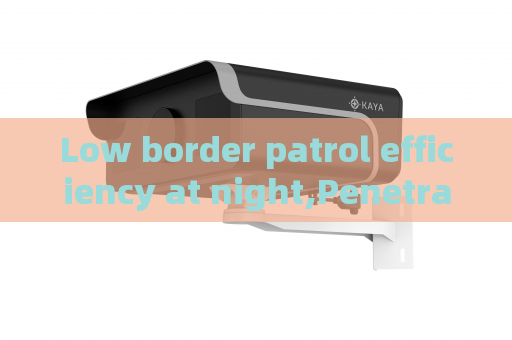
Low border patrol efficiency at night, Penetrating Imager utilizes Low-light Imaging to improve anti-smuggling operational efficiency Night operations along open borders pose persistent challenges for anti-smuggling units. Smugglers exploit darkness, tinted vehicle glazing, and remote crossing points to conceal contraband and evade detection. Traditional patrol approaches rely on flashlights, spotlights, or physical inspection, forcing officers to approach vehicles at close range before any visual assessment is possible. This creates a dangerous window of uncertainty: a vehicle could contain armed individuals, stacked cargo, or hidden compartments. The result is a slow, cautious process that reduces checkpoint throughput and leaves vast stretches of border under-monitored. Low border patrol efficiency at night is not merely a matter of technology gaps; it directly endangers officers and allows smuggling networks to operate with predictable impunity. The Penetrating Imager offers a response to this operational weakness by changing what a patrol officer can see before a single step is taken toward a suspect vehicle. The Penetrating Imager utilizes low-light imaging as part of its active, laser-based range-gated imaging architecture. At the core of the device are a high-repetition-rate pulsed laser, an image-intensified gated camera with an internal MCP image intensifier, high-voltage and timing modules, a beam expander, and an imaging lens. This optical instrument emits short pulses of light and opens the camera shutter only when reflected light from the target returns, effectively rejecting backscatter from fog, rain, snow, or airborne particles. In darkness, the system delivers high-contrast imagery over a useful operational distance, with strong resistance to ambient interference. Because the Penetrating Imager is an active imaging system, it does not depend on moonlight or street lamps. For border patrol in a blacked-out rural environment, this means a checkpoint officer can perform through-glass surveillance of an approaching vehicle from a standoff position, seeing occupants and cargo through side windows, windshield, or rear glass without any visible light that would telegraph observation. Operationally, the Penetrating Imager transforms the night-time vehicle check. An officer positions the unit at the patrol post, aims it at an approaching car, and obtains a real-time image of the cabin through the automotive glass. Because the technology only penetrates optical media—vehicle windows, windscreens, and similar transparent barriers—it fits precisely within the legal and tactical scope of a traffic control point. Distinguishing features such as occupant count, limb movement, or large concealed items behind seatbacks become visible. The low-light imaging capability ensures that even with the vehicle’s interior dark or the glass heavily tinted, the reflected laser light builds a readable picture. Officers can then decide whether to wave the vehicle through or direct it to a secondary inspection area, removing the need to open every door and trunk at the primary line. Multiple checks per hour become possible without compromising safety, directly addressing the throughput bottleneck that has long defined night patrol work. Under typical border conditions—mist over river crossings, light rain, or dust stirred by vehicle tires—the Penetrating Imager maintains its imaging advantage. The gated timing module filters out scattered light from these obscurants, while the high-repetition-rate laser supplies consistent illumination across the inspection zone. In extreme cases of thick smoke, such as a vehicle fire at a checkpoint, the Penetrating Imager improves visible range by three to five times but cannot fully defeat dense smoke; operators know this limitation and rely on the system where glass and darkness are the primary obstacles. This focused capability keeps the instrument firmly within the optical domain, using light itself to overcome darkness and glazing. For border patrol units seeking a practical, non-contact method to inspect vehicles at night, the Penetrating Imager with its low-light imaging engine replaces guesswork with observable fact. Anti-smuggling operations gain speed, standoff distance, and situational awareness in a single handheld instrument, making the night shift a far less inviting target for those who would cross with contraband.




