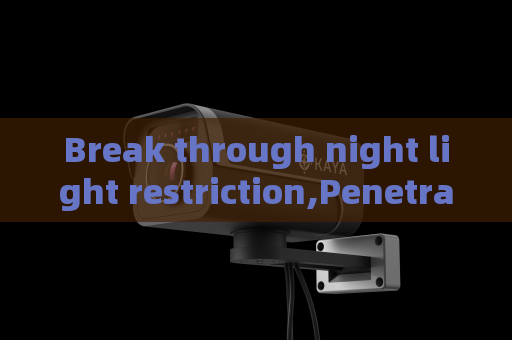
Break through night light restriction, Penetrating Imager adopts Zero-light Imaging to realize unrestricted night reconnaissance Night reconnaissance in urban environments often collapses under a single overwhelming constraint: darkness. When a suspect vehicle idles under a broken streetlamp or in an unlit alley, conventional optics fail. Night vision devices amplify ambient photons, but they are helpless in true darkness. More critically, the target sits behind automotive glass—tinted, reflective, or rain-streaked. Officers on a covert stakeout cannot risk switching on a flashlight, cannot move closer without breaking cover, and cannot rely on thermal signatures through glass because tempered panes block long-wave infrared. The tactical problem is not merely seeing in the dark; it is seeing through a specific optical barrier while remaining completely undetected. That is the real pain point: night offers no light, and glass offers no visual access. Without a solution, a routine traffic stop or a high-risk warrant becomes a guessing game at twenty meters. The result is hesitation, delayed decisions, or the need to close distance and expose the team to hostile fire. What the operator needs is a tool that creates its own light, penetrates the vehicle window, and delivers a clear image without any active illumination visible to the target. The penetrating imager solves this exact scenario through one decisive capability: Zero-light Imaging. Unlike passive intensifier tubes that require at least a trace of moonlight or starlight, the penetrating imager is an active optical system built on laser range-gated imaging technology. A high-repetition-rate pulsed laser illuminates the scene in the near-infrared spectrum, while an intensified gated camera—equipped with an MCP image intensifier, high-voltage module, and timing circuitry—opens its shutter only for the precise nanoseconds when reflected photons return from the target. This time-gating mechanism rejects backscatter from fog, rain, or atmospheric particles, and it also suppresses the blinding flare of headlights or streetlamps. For through-window tactical observation, the same technique works because the laser light passes through automotive glazing, reflects off the occupants and interior surfaces, and returns to the sensor. The operator sees a crisp, high-contrast image of the suspect’s hands, face, and movements—even if the windows are tinted and the interior is pitch black. The system does not emit any visible flash, no red dot, no glow. It is a passive-looking active imager. That combination—zero ambient light, zero visible signature, full glass penetration—turns impossible night reconnaissance into routine observation. In practice, the operation unfolds with quiet simplicity. A two-person surveillance team parks at a tactically sound angle, roughly thirty to fifty meters from the target vehicle. The operator raises the penetrating imager on a stabilized mount, frames the target through the onboard display, and adjusts gain and gate delay to match the distance. The laser illuminates, the gated camera integrates only the light bouncing off the interior of the target car, and the screen shows a clear silhouette through-tinted side glass. Hand movements become visible. A driver reaching toward the glovebox, a passenger leaning forward, the glint of a metallic object—all appear with enough detail to drive a go/no-go decision. The system’s strong light suppression function keeps the image usable even if the target suddenly switches on the interior dome light. Because the imaging is fully electro-optical and relies on reflected laser light rather than thermal emission, the image preserves depth and spatial contrast in a way that infrared scanners cannot. The team can maintain covert through-glass reconnaissance for extended periods, uploading stills or video to the command post via a standard video link. No door is opened, no window tapped, no approaching officer exposes himself. The reconnaissance continues until the target either commits to a route or the tactical team receives the final signal to move. This is the difference between hoping for enough light and creating a controlled, invisible source of illumination that defeats both darkness and glass—penetrating imager gives the observer the night, without ever telling the observed that anyone is watching.




