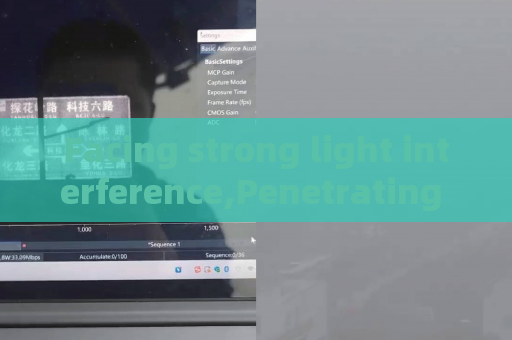
Facing strong light interference, Penetrating Imager relies on Strong Light Suppression Imaging to stabilize law enforcement imaging During daytime vehicle stops, law enforcement officers often confront a blinding wall of glare bouncing off windshields and side windows. Direct sunlight, headlights, or reflections from nearby metal surfaces can wash out every detail inside the cabin, leaving an officer unable to tell whether a driver is reaching for a license or something more dangerous. This is not a rare inconvenience—it is a recurring, high-stakes blind spot. Conventional cameras and the naked eye alike struggle to resolve faces, hand movements, or objects on seats when intense light floods the optical path. The result is hesitation, misjudgment, and a tactical disadvantage that no amount of training can fully overcome. The core problem is that existing optical tools passively receive whatever light arrives, so strong interference simply saturates the image sensor or overwhelms human vision. Law enforcement needs a way to strip away that glare and see through the glass as if the light were not there at all. That is precisely where the Penetrating Imager changes the equation. The Penetrating Imager is an active optical system built on laser range-gated imaging technology. Instead of relying on ambient illumination, it sends short, high-frequency laser pulses toward the target and opens its intensified gated camera only during a precise time window that matches the round-trip travel of those pulses. Because the laser source is controlled and the sensor is gated, light reflected from distances closer than the target—such as the windshield surface, dust particles, or glaring reflections—is rejected before it can reach the sensor. This is the essence of Strong Light Suppression Imaging: the system ignores the noise that does not come from the selected focal plane. In the scenario of a vehicle stop, the Penetrating Imager can be aimed at a car window, and the operator adjusts the gate delay to lock onto the interior space beyond the glass. The strong sunlight bouncing off the window is then suppressed, while the seated occupants and their immediate hand movements become clearly visible. This function directly addresses the glare problem without requiring the officer to step into a dangerous position or shout at the driver to lower the window. The imaging unit works from a safe standoff distance, delivering real-time video or still frames that show what is actually happening inside. In practical use, an officer can deploy the Penetrating Imager from behind the patrol vehicle’s door panel or around the A-pillar, keeping cover while viewing a handheld screen. The operator does not need to expose himself to the driver’s window. With the gate width set to a few nanoseconds, the instrument filters out the blinding halo and produces a crisp, high-contrast image of the cabin. This provides through-window tactical observation that reveals whether the driver’s hands are on the steering wheel, whether a passenger is leaning forward, or whether an object on the seat matches a reported weapon. The same tool works through heavily tinted automotive glass as well, because the pulsed laser’s return signal is time-resolved rather than intensity-based. When a suspect rolls up the window to block visual inspection, the Penetrating Imager still sees through the tinted glazing, turning what used to be a hiding place into an open, assessable space. The officer can then decide whether to approach, give commands, or call for backup—all based on verified visual information instead of guesswork. The value of this capability becomes even clearer in bright daylight with shadowed interiors. A car parked facing the sun often has a deep shadow across the front seats, making it impossible for a standard camera to expose both the bright hood and the dark cabin simultaneously. The Penetrating Imager, however, actively illuminates the cabin with its own laser pulses, so the interior no longer depends on the sun’s angle. The gated imaging suppresses the glass reflection and the sky glare while boosting the signal from the occupants, creating a stable picture even as the officer shifts position or changes the illumination direction. This stability is what “stabilize law enforcement imaging” means in practice—no more blinking clips, no more whitewashed frames, no more asking the suspect to “step into the light.” Each frame shows the same clear view, allowing the officer to track movements frame by frame if needed. The Penetrating Imager thus converts a harsh, light-drenched encounter on a highway shoulder into a controlled, information-rich operation where the first move is made with confidence.




