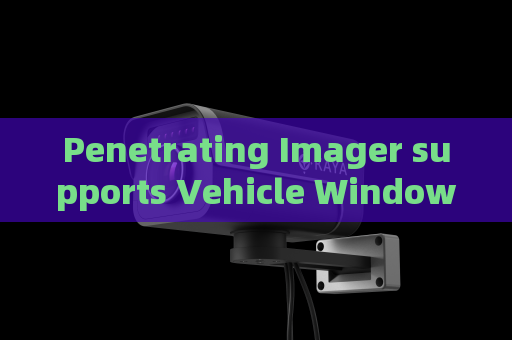
Penetrating Imager supports Vehicle Window Penetration, completing hidden monitoring for urban night law enforcement Urban night law enforcement faces a persistent blind spot: the cabin of a suspect vehicle cannot be observed from a safe distance. A parked car in a dim alley or a driveway may hide occupants who are preparing a drug exchange, storing a weapon, or waiting for a target. Tinted automotive glass, dashboard reflections, and the absence of ambient light defeat conventional visual tools. Standard night-vision devices amplify reflected light but are overwhelmed by the glare of street lamps striking the glass. Thermal cameras provide a heat silhouette, yet they cannot reveal whether a hand is holding a cell phone or a handgun. To gain information, officers must physically approach the vehicle and risk exposure. This operational gap is precisely what a penetrating imager can address. By enabling vehicle window penetration, the device turns the windshield into an observation window for hidden monitoring during urban night law enforcement. The penetrating imager is an active optical imaging system built upon laser range-gated imaging technology. Its core components include a high-repetition pulsed laser, an intensified gated camera with an internal microchannel plate image intensifier, a high-voltage module, a timing controller, a beam expander, and an imaging lens. The pulsed laser illuminates the scene with short bursts of light. The gated camera opens its electronic shutter only for a precise time window corresponding to the round-trip distance to the target surface. This range-gated mechanism filters out backscattered photons from rain, haze, or airborne particles and suppresses the strong specular reflection from the outer layer of the vehicle's glass. The resulting image shows the cabin interior with high contrast and clear spatial detail. Being a purely optical instrument, the penetrating imager is restricted to transparent media such as vehicle windows, high-speed train glazing, aircraft portholes, and glass curtain walls. It cannot image through concrete, brick, metal, wood, or clothing. This active gating technology provides long observation range, high resolution, and strong resistance to interference, making it well suited for vehicle window penetration in urban night law enforcement. Deployment in an urban night operation follows a simple and rapid procedure. The imager is mounted on a tripod inside an unmarked surveillance van or positioned behind a low wall at the edge of a parking lot. The operator points the lens through the suspect vehicle's side window or windshield and adjusts the penetrating imager's gate delay until the depth of field matches the interior plane. With the gate set, this direct vehicle window penetration capability makes the cabin appear as if the glass had been removed. Dark factory tint films remain fully transparent because the film is an optical layer, not an opaque material. This permits covert through-glass recon of the front seats, the rear bench, and even the center console. Officers can track the occupant's hands, observe facial expressions, and identify whether a weapon is resting in a lap or against a door panel. The invisible laser illumination ensures the hidden monitoring produces no visible indication of surveillance. Strong light suppression circuitry handles street lamps, headlight beams, and other bright sources without washing out the image, preserving crucial details in shadows. In a poorly lit commercial district, a suspect vehicle sits stopped at a curb. The driver is talking on a phone while reaching toward the glove compartment. In a conventional response, officers would have to illuminate the car with a spotlight, announcing their presence and triggering a possible confrontation. With the penetrating imager executing vehicle window penetration at a distance of sixty meters, the entire sequence is observed through the automotive glass. The same device performs in complete darkness and in drizzling rain, as the gated optics reject backscatter from precipitation. This makes the visual intelligence continuous and reliable. The officer in command can decide to wait until the driver exits the vehicle or to move in when the subject's hands are visible and occupied. The penetrating imager completes hidden monitoring for urban night law enforcement by providing through-glass covert observation of a stationary vehicle. Its role is not to replace aerial surveillance or license-plate cameras, but to fill the precise gap at the car window—where the most critical pre-contact information is found.




