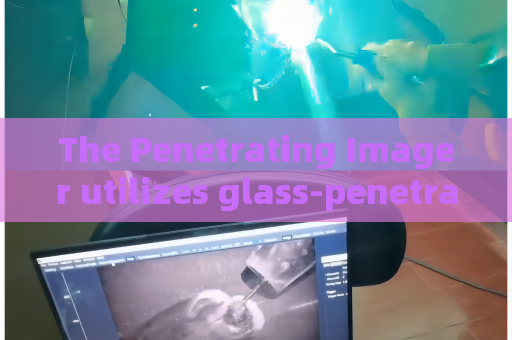
The Penetrating Imager utilizes glass-penetrating imaging to support anti-terror tactical missions for armed police teams An armed police team responding to a hostage situation or vehicle-borne threat often faces a single frustrating barrier: automotive glass. A suspect inside a car can be fully visible to the naked eye, yet the tactical picture remains incomplete. Sunlight bouncing off the windshield, factory-tinted privacy glass, and the angle of the vehicle all turn a routine check into a dangerous guessing game. Without reliable visual confirmation of what is happening inside, operators must choose between exposing themselves to approach the window or waiting for the suspect to make the first move. This blind spot is not a matter of equipment failure but of physics—ordinary cameras and binoculars simply cannot separate the reflected light from the object behind it. The Penetrating Imager changes that dynamic by turning a transparent barrier into a tactical advantage. The Penetrating Imager is an active optical system built around laser range-gated imaging, or gated imaging technology. A high-repetition pulsed laser illuminates the target zone, while an intensified gated camera—equipped with an MCP image intensifier, high-voltage module, and timing module—opens its shutter only for the brief window when light reflected from the target returns. This precise time gating rejects the backscattered light from the glass surface and atmospheric particles, enabling a clear view through the windshield or side window even under glare or low ambient conditions. For a tactical team, this means through-window tactical observation becomes possible from a safe standoff distance. The operator can see through a car window, a high-speed train window, or an aircraft porthole without placing any person in the kill zone. Vehicle window penetration is achieved with the same clarity as if the glass were not there, allowing the team to assess hand placement, suspicious wiring, or the presence of a weapon before making entry decisions. In practice, the device is deployed like a precision binoscope on a tripod or vehicle mount. The operator aligns the imaging head toward the target vehicle, adjusts the gate delay to match the measured distance, and immediately obtains a high-contrast video image of the interior cabin. Because the system is fully active, it functions in low-light and even zero-light conditions without betraying its position—the laser pulse is not visible to the naked eye. The image is displayed on a ruggedized screen or through a tactical head-mounted display, giving the commander real-time situational awareness without a single voice transmission. During a multi-vehicle checkpoint, for example, the team can sweep each approaching car from 50 meters away, identifying whether the driver’s hands are on the wheel or hidden below the dashboard line. The ability to perform covert observation through vehicle glazing, even when the glass is heavily tinted, reduces the need for risky close-range checks. The tactical value reaches its peak in vehicle ambush scenarios. When a suspect vehicle stops at a roadblock, the armed police team members are trained to approach with caution, but the first few seconds remain the most lethal. With the Penetrating Imager stationed at the flank, the commander sees through the rear window and the left-side glass simultaneously, spotting a raised pistol barrel or a passenger’s body posture shifting toward the door. The system’s immunity to strong light suppression—such as a suspect shining a flashlight directly at the camera—ensures the image remains stable. Since the technology only processes reflected light, there is no emission of any rays beyond the optical spectrum, and it cannot look through doors, walls, or clothing. But for the narrow, high-stakes problem of automotive glass, the Penetrating Imager provides the decisive visual edge that turns uncertainty into actionable intelligence. Every second saved in that observation window is a second added to the team’s reaction envelope.




