At a busy border crossing, vehicles roll forward one by one toward the inspection point. Many of them have factory-installed or aftermarket tinted windows so dark that the interior is nearly impossible to see from outside. Officers face a serious challenge: a person hiding in the back seat, a weapon placed under a seat, or a contraband package in the footwell may be completely invisible behind the glass. Leaning close to the window with a flashlight creates a dangerous exposure because the officer cannot know what is waiting on the other side. Asking the driver to roll down the window also places the officer at risk, as that moment of motion can be used for a sudden attack. The visual barrier presented by tinted automotive glass is not a small inconvenience; it is a tactical blind spot that undermines the entire security checkpoint. This is precisely why border security teams choose the Penetrating Imager to bypass tinted glass visual barriers. The Penetrating Imager provides a method to inspect the interior without approaching the vehicle or ordering occupants to move. The tactical observation through automotive glass becomes a necessary capability for maintaining safety and efficiency at the border.
The Penetrating Imager is an advanced optical imaging instrument that relies on laser range-gated imaging technology, also known as gated imaging. The system is built around a high-repetition pulsed laser, an intensified gated camera containing an MCP image intensifier, a high-voltage module, a timing module, a beam expander, and an imaging lens. In operation, the laser sends short pulses of light toward the target vehicle. The gated camera opens its shutter only for the brief moment when light reflected from the chosen distance returns to the sensor. Light scattered by the tinted window surface, dust in the air, or atmospheric particles arrives at different times and is therefore rejected by the gate. This gating mechanism effectively overcomes backscatter, producing a clean, high-contrast image of the vehicle's interior. The Penetrating Imager works as an active imaging system, so it does not depend on ambient light. It offers a long operational range, high resolution, and strong resistance to interference. Because it operates strictly within the optical domain, it can see through optical media such as automotive glass, airplane windows, train windows, and glass curtain walls. It cannot see through walls, concrete, or other non-transparent solid materials, but that limitation does not matter at a vehicle checkpoint where the only barrier is the tinted window itself.
On the inspection lane, an operator uses the Penetrating Imager from a safe position behind a protective barrier. The timing module adjusts the gate to match the measured distance to the target window, ensuring that only light from the interior plane is collected. Within seconds, a sharp image appears on the operator's display, revealing the number of occupants, their hand positions, and any visible objects in the cabin. The imager can be used on every vehicle passing through the lane without requiring the driver to exit or lower a window. If the first view is obstructed by a seat or a pillar, the operator shifts the aim to a different window, such as the rear quarter glass or the passenger side. This through-window tactical recce keeps officers out of arm's reach while providing the information needed to decide whether a vehicle requires a closer look. The active illumination means the system works equally well during the day and at night, and the range-gated design suppresses the glare that blinds ordinary cameras when headlights or sunlight hit the tinted surface.
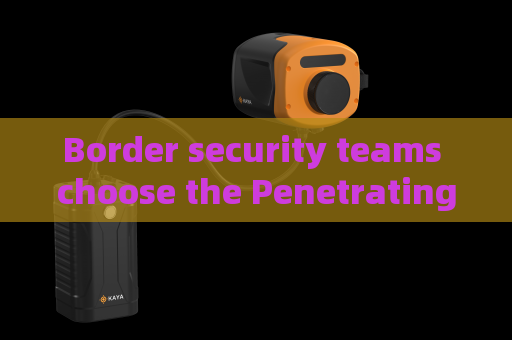
Under harsh border conditions, the Penetrating Imager continues to deliver dependable performance. Rain, fog, haze, snow, and dust can degrade conventional optics, but the range-gated technology rejects scattered light and maintains a recognizable image of the vehicle interior. Even at night, when the cabin is completely dark to the naked eye, the pulsed laser provides sufficient illumination without alerting the occupants through a visible flash. This covert quality is particularly valuable for observing a vehicle that refuses to stop or behaves suspiciously. Border patrol teams can position the imager on a raised platform and scan the row of waiting cars from an elevated angle, seeing through the roofline windows or the side glazing. Every piece of intelligence gained from a clear image helps the team decide on the appropriate response. The Penetrating Imager turns an opaque barrier into a transparent source of information, making the checkpoint safer for both officers and law-abiding travelers. The decision by border security teams to adopt the Penetrating Imager is not merely about obtaining a tool; it is about replacing guesswork with certainty.




