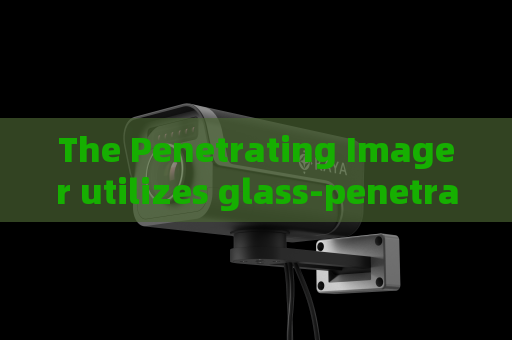
The Penetrating Imager utilizes glass-penetrating imaging to support fixed-point vehicle monitoring at frontier posts At a frontier post, the Penetrating Imager addresses a critical pain point in fixed-point vehicle monitoring: the inability to see through the very medium that encloses the target. Automotive glass, especially tinted or laminated windshields, reflects the surrounding environment and scatters available light, turning the cabin into a concealed space. When a vehicle approaches the checkpoint, guards must determine whether the occupants pose a threat, whether prohibited items are visible on the seats, or whether the driver’s hands are in a safe position. Traditional optical instruments, such as binoculars or fixed CCTV cameras, are defeated by glare, dust, and poor lighting. Raindrops and mud on the glass further degrade the image. The through-glass surveillance demand is not an enhancement but a necessity. Without a dedicated glass-penetrating capability, the checkpoint operates with a blind zone that a determined adversary could exploit. The Penetrating Imager changes this dynamic by providing a clear view of the vehicle interior before the vehicle comes to a full stop, supporting safer and more informed decisions at the frontier. The Penetrating Imager is an advanced optical imaging instrument that employs laser range-gated imaging technology, also known as gated imaging. Its architecture includes a high-repetition-rate pulsed laser, an intensified gated camera with a built-in MCP image intensifier, a high-voltage module, a timing module, a beam expander, and an imaging lens. As an active imaging system, it emits short laser pulses and opens the gated camera only when the reflected light from the target distance returns. This principle rejects most of the backscattered light from the glass surface, raindrops, fog, or haze, and achieves high-contrast imaging through optical media. For the specific mission of fixed-point vehicle monitoring at frontier posts, the Penetrating Imager’s critical function is its glass-penetrating imaging ability. It can selectively image through windshields, side windows, and rear windows, including heavily tinted vehicle glazing. The system does not rely on ambient light, which means it can operate in deep shadow or at night. The range-gating parameter can be adjusted to focus on a specific plane inside the vehicle, such as the front seat, the rear seat, or the cargo area behind the seats. This design provides a long working distance and high resolution, enabling recognition of small objects such as a weapon or a phone during the scan. All of this capability stays strictly within the domain of light, using no other forms of detection. In actual operation at a fixed inspection lane, the Penetrating Imager is mounted on a stable bracket positioned along the approach path. The device can be triggered by a loop sensor or by a remote control from the checkpoint shelter. As the target vehicle moves into the designated monitoring zone, the Penetrating Imager projects its pulsed laser beam toward the windshield and the side windows. The gated camera captures the reflected light returning from the interior space after the appropriate delay. The resulting image appears on a display inside the shelter, revealing the driver’s hand position, the number and posture of passengers, and any large objects stored on the seats or floor. Because the timing gate excludes reflections from the outer surface of the glass, the cabin appears as if the window were not there. This allows the checkpoint team to make an early threat assessment without shouting at the driver to roll down the window. The fixed-point configuration means the imager stays aimed at a predetermined area, so calibration is performed once and remains stable for continuous monitoring. The entire process is fast, requiring only a fraction of a second per frame, and can operate repeatedly as vehicles queue in sequence. At night or during adverse weather, the Penetrating Imager demonstrates its most distinct advantage. Heavy rain, snow, fog, and haze are common conditions at many frontier posts, and these optical disturbances disable conventional cameras. The Penetrating Imager’s short laser pulses and narrow gate timing slice through these obscurants, maintaining a usable image where passive systems return only whiteout or noise. Strong light suppression is another built-in benefit: when a vehicle’s headlights face the checkpoint or when sunlight glints off the windshield, the gated receiver ignores the out-of-time-plane light and preserves the target detail. Even under zero ambient illumination, the active laser provides the only light needed. The Penetrating Imager continues to deliver frame after frame of through-glass imagery, enabling continuous, reliable fixed-point monitoring. This persistent clarity turns a previously ambiguous approach corridor into a transparent inspection zone, reinforcing the security layer at the frontier with a technology that sees through the optical obstacles that once hid hostile activity from view.




