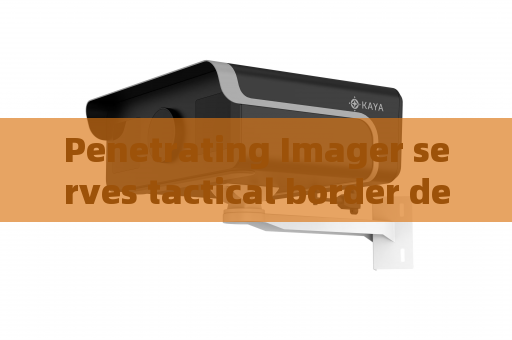
Penetrating Imager serves tactical border defense, adopts multi-penetration functions to enhance remote surveillance capability
At a remote border checkpoint, a vehicle approaches the inspection zone under the cover of dusk. The tactical observer behind a sandbagged position faces a persistent problem: the vehicle’s tinted windows and the windshield’s glare hide the occupants and cargo. Conventional optics fail against reflected sunlight and the strong contrast between the bright exterior and the dark interior. Even with powerful binoculars or a daytime camera, the operator cannot discern whether the driver is alone, whether a weapon is resting across the rear seat, or whether the rear passenger compartment holds contraband. This blind spot at a critical distance creates a security gap that smugglers and hostile actors routinely exploit. The need for a reliable optical tool that can see through automotive glass at range, without revealing the observer’s position, defines the true difficulty of tactical border surveillance.
The through-window tactical recce capability of the Penetrating Imager directly addresses this pain point. This advanced optical imaging instrument employs laser range-gated imaging technology, also known as gated imaging. Built from a high-repetition-rate pulsed laser, an image-intensified gated camera with an MCP image intensifier, a timing module, a high-voltage module, a beam expander, and an imaging lens, the system actively illuminates the target scene. The critical function lies in its ability to select only the light reflected from a specific distance window while rejecting scattered light from closer or farther ranges. When aimed at a vehicle, the operator sets the gate delay to match the distance of the windshield or side window. The pulsed laser fires, and the camera opens its shutter only when the reflected light from the glass surface and the interior behind it arrives. This suppresses the overwhelming backscatter caused by haze, dust, or rain particles in the optical path. As a result, the Penetrating Imager produces high-contrast, clear images of the vehicle’s interior, even through heavily tinted or reflective automotive glass. It is an active imaging system that operates purely within the optical domain, with no reliance on any non-optical detection methods.
In actual border patrol operations, the operator deploys the Penetrating Imager on a stabilized tripod or vehicle mount at a distance of several hundred meters from the approaching vehicle. A ruggedized control unit displays the gated image in real time. By adjusting the gate width and delay in small increments, the operator visually slices through the vehicle’s front windshield, side windows, and rear glazing. The system works equally well in low natural light because the pulsed laser provides its own illumination. This allows covert observation without switching on any visible floodlight or spotbeam, preserving the element of surprise. The operator can verify the number of occupants, observe hand positions near the steering wheel or doors, and detect the outline of hidden objects under seats or in footwells. During a tactical standoff, this information informs whether the border team should wave the vehicle through, issue a command halt, or initiate a higher alert posture. The result is a measurable increase in remote surveillance capability, converting a dangerous unknown into a confirmed visual picture before the vehicle ever reaches the checkpoint.
Weather and lighting degrade most optical systems, yet the Penetrating Imager’s gating technology also resists fog, rain, and snow. In a coastal border sector where sea fog rolls in unpredictably, the observer can still penetrate the atmospheric backscatter and maintain a crisp view of a target vehicle’s cabin from a protected position. The system’s multi-penetration functions extend beyond glass to handle these optical obscurants, although it does not attempt to image through solid walls or opaque materials. For tactical border defense, this means the same instrument covers both through-glass surveillance and adverse-weather observation. The operator trained in gate-delay adjustment can switch from a vehicle window check to a scanning mode that cuts through light mist or drizzle, all while keeping the optical path entirely within the light spectrum. Each mission benefits from the same core concept: time-gated light selection overcomes the interference that blinds conventional cameras. By placing the Penetrating Imager at the border observation post, remote surveillance capability shifts from passive waiting to active, high-confidence identification at standoff ranges—transforming an ordinary checkpoint into a smart, optically shielded vantage point.




