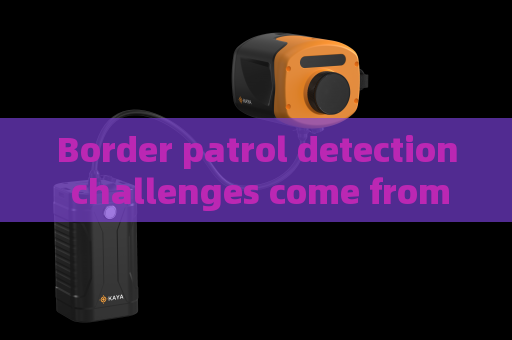
Border patrol detection challenges come from harsh backlight. At dawn, the sun sits low on the horizon and turns the entire patrol corridor into a blinding wash of yellow-white. A human figure walking along the fence line collapses into a dark, featureless cutout. Optical zoom lenses suffer from glare and internal flare. Every edge becomes a smeared line, every shadow a potential threat. Border agents must make split-second decisions with incomplete visual information. This is the real problem: not the presence of targets, but the absence of contrast. The background light overwhelms the foreground signal. Ordinary cameras try to compensate by adjusting exposure, but they only brighten the entire frame, washing out the target further. The Penetrating Imager addresses this exact failure mode. The Penetrating Imager is an active optical system built on laser range-gated imaging. Its core components are a high-repetition pulse laser, a beam expander, an imaging lens, and an intensified gated camera with an MCP image intensifier, high-voltage module, and timing module. The system fires pulses through the expander and lens, while the camera opens its shutter only for the short interval when the laser light reflected from the target returns. Any light arriving before the gate opens or after it closes, including the intense background backlight from the sun or from reflective surfaces, is rejected. The instrument does not attempt to overpower the background; it simply confines its detection to the light that comes from the precise distance of interest. This gating principle provides a natural suppression of light interference. Strong Light Suppression Imaging emerges from the combination of narrow timing and active illumination, allowing the camera to see a subject that would otherwise be obscured by a bright halo. The resulting image has high contrast and high resolution, enabling the operator to discern clothing outlines, limb movement, and even facial orientation at a meaningful distance. In a border patrol scenario, this capability proves decisive when observing through vehicle windows. Suspect vehicles often have tinted glass that reflects the morning sun back toward the observation post. A conventional spotting scope receives that reflected glare and does not recover the occupant. The Penetrating Imager, directed at the same window, sends out pulsed laser light. Because the system knows the distance to the vehicle and the timing of the returning echoes, it can select the reflection from the people inside while discarding the glare from the glass surface. The operator sees a clean picture of the interior scene despite the harsh backlight. The same function works at fixed checkpoints, where the instrument can be placed behind a darkened barrier or mounted in a patrol vehicle. Its range-gated operation also functions in very dim ambient light and complete darkness, so the transition from daytime backlight to night darkness requires no adjustment of the core approach. The operational sequence is simple and rapid. The border agent aims the Penetrating Imager at the target vehicle and presses the activation switch. The timing module is set according to the estimated distance, easily adjusted with a calibration knob. A short burst of laser pulses is emitted, and the gated camera captures only the desired return. The display shows the vehicle interior in real time, with sunlight reduced to a faint background haze. Deliberate adjustments of the gate window allow the operator to scan from the front windshield to the rear seat, slicing through the reflective layer at each depth. This function directly counters the original difficulty: Border patrol detection challenges come from harsh backlight. The Penetrating Imager restrains light interference effectively, turning a blinding glare scene into a readable image. The entire process takes seconds, requires no physical contact with the car, and relies entirely on optical techniques. It is a practical answer to one of the oldest problems in border security.




