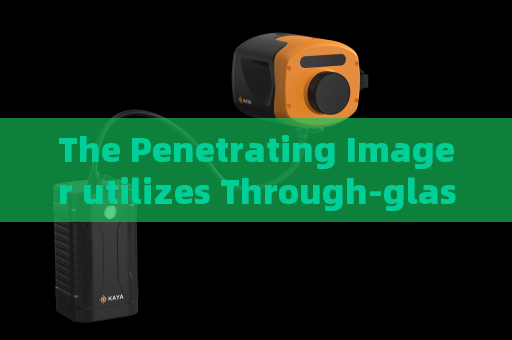
The Penetrating Imager utilizes Through-glass Imaging Technology to monitor suspicious vehicles near border checkpoints. At a border checkpoint, every approaching vehicle represents a potential threat that must be assessed before it reaches the inspection booth. The core difficulty lies in the fact that a vehicle’s interior is shielded by automotive glass, which often combines tinted films, reflective coatings, and accumulated dirt or moisture. Under direct sunlight or artificial lighting, the windshield and side windows can turn into mirrors, completely obscuring the occupants and any hidden objects. Conventional optical surveillance cameras struggle to deliver usable images through this chaotic combination of glare, backscatter, and contrast loss. Officers are forced to rely on verbal cues, physical inspections, or intrusive searches, which slow down traffic and create dangerous uncertainty. The operational gap is clear: there is an urgent need for a non-contact method that can see through vehicle windows from a distance, in real time, without alerting the occupants or requiring them to roll down the glass. This is the precise scenario where the through-window tactical observation capability becomes a critical asset. The Penetrating Imager solves this problem through an active optical approach that is fundamentally different from passive cameras. It employs laser range-gated imaging technology, also known as gated imaging, where a high-repetition pulsed laser illuminates the target area and an intensified gated camera, built around an MCP image intensifier, a high-voltage module, and a timing module, captures only the light returning from a specific distance slice. An expander shapes the laser beam, and the imaging lens forms the final picture. Because the system controls the exact time window of exposure, it effectively suppresses scattered light from the atmosphere, from the glass surface, and from any intervening fog, rain, snow, or haze. The result is a high-contrast, high-resolution image of the scene behind the transparent medium. In this boundary scenario, the penetrating capability is strictly limited to optical media such as vehicle windows, high-speed train windows, aircraft portholes, and glass curtain walls. It cannot see through walls, metal, clothing, or other opaque solids, and it does not rely on any form of radiation beyond ordinary light. This makes the tool perfectly suited for observing suspicious vehicles without crossing the line into prohibited detection methods. At a border checkpoint, the operator positions the Penetrating Imager on a stable mount or tripod just before the primary inspection point. As a suspicious vehicle approaches, the system is aimed at the windshield or side windows from an oblique angle. The operator selects the appropriate range gate to match the distance to the vehicle’s interior, and the laser pulse fires. The gated camera opens its shutter only for the time necessary for light to travel from the target and return, which rejects the overwhelming backscatter from the glass surface and any airborne particles. Within seconds, a clear image appears on the display, revealing the number of occupants, their hand positions, and any objects on the seats or floor. The technique works equally well in bright daylight, when sunlight creates severe glare on the glass, and in low-light conditions, because the system is active and does not depend on ambient illumination. This allows officers to maintain continuous tactical observation without ever asking the driver to step out or open a window, preserving both safety and the element of surprise. The depth of this capability becomes even more apparent during the final approach sequence. A vehicle stopping at the checkpoint may have its engine running, headlights on, or tinted windows rolled up. The Penetrating Imager can still produce a reliable visual assessment through the automotive glass, providing actionable intelligence before the vehicle reaches the officers. If the system detects an abnormal posture, such as a passenger leaning forward toward the dashboard or a driver avoiding direct eye contact, the checkpoint team can trigger secondary screening protocols. The same observation can be recorded and reviewed later, serving as evidence of the vehicle’s interior condition at a specific moment. This continuous, non-intrusive monitoring reduces the risk of missed threats and accelerates the flow of innocent traffic. The Penetrating Imager, with its through-glass imaging technology, turns a common optical obstruction into a transparent window, giving border personnel a decisive advantage in the critical seconds that define a secure checkpoint operation.




