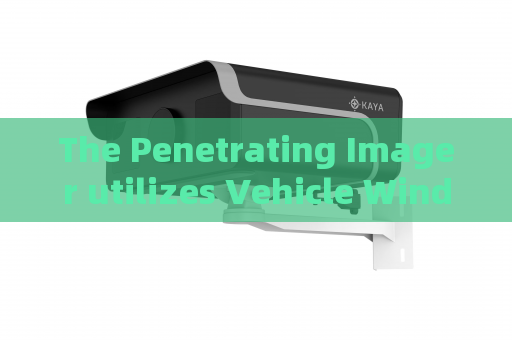
The Penetrating Imager utilizes Vehicle Window Penetration for covert military vehicle reconnaissance at border outposts. At a border outpost, the approach of an unknown vehicle presents a serious problem. Windshield glare, tinted glass, dust, and shifting daylight often combine to hide the occupants and cargo from static observation posts. A sentry who cannot see inside a car at a safe distance must either call the vehicle to a halt and walk toward it, or wait until it reaches a checkpoint. Both actions give up the advantage of surprise and place personnel inside the lethal radius of a potential ambush or vehicle-borne attack. The genuine pain point is not simply bad visibility; it is the lack of stand-off, covert visual access to the vehicle’s interior. Guards need to see through vehicle glass without revealing their observation position or exposing themselves. That requirement points directly to a Penetrating Imager capable of covert military vehicle reconnaissance through a closed window at a distance. The Penetrating Imager solves this with an entirely optical method. It is an active imaging system built around a high-repetition pulsed laser, an intensified range-gated camera, a beam expander, and an imaging lens. Instead of relying on ambient light, the device sends out short laser pulses and opens the camera shutter only when light reflected from the selected target distance returns. This time-gating principle suppresses backscatter caused by rain, snow, fog, and the glass surface itself. Through Vehicle Window Penetration, the imager can look squarely through automotive glazing and create a clear, high-contrast image of the space behind it. The same mechanism naturally cancels strong sunlight or headlight glare, so the view is not washed out in bright conditions. Every detail in the image comes from laser light reflected by the scene. Because the Penetrating Imager is designed for through-glass covert observation, it works on vehicle windows, side mirrors, and sunroofs without any physical contact. In practice, the system is set up inside a border post or beside a concealed firing position. The operator points the Penetrating Imager at the approaching vehicle, selects the range gate corresponding to the far side window, and receives a video image of the vehicle’s interior. The target driver never notices the observation because no visible beam is required—the laser light is near-infrared and the optical aperture is small. At a distance of several hundred meters, the operator can count the number of people, identify raised hands or weapons, and see objects such as heavy clothing, containers, or wiring. If the environment is dusty or the road is lined with haze, the range-gating technique still maintains a usable picture by rejecting most of the scattered light. The observation can be continued continuously as the vehicle moves through the approach lane, which gives the commander time to decide whether to wave the vehicle through, order a manual inspection, or deny entry. At the checkpoint itself, the Penetrating Imager becomes a force multiplier. A guard on the far side can perform a tactical visual check through tinted windows before the vehicle reaches the gate, while another officer remains under cover. The approach lane remains under continuous visual control from the moment the vehicle appears on the horizon. This method shrinks the window of vulnerability and removes the need for mirrors on poles or risky close-up inspections. For long nights on the border, the same device remains effective in zero-light conditions because the laser provides its own illumination. Every observation is recorded, creating evidence that does not depend on the memory of a tired sentry. The Penetrating Imager does not change the rules of engagement; it simply gives the outpost the optical advantage of seeing through glass from somewhere safe. That advantage is the difference between reacting to a threat and having already confirmed its nature before the vehicle enters the perimeter.




