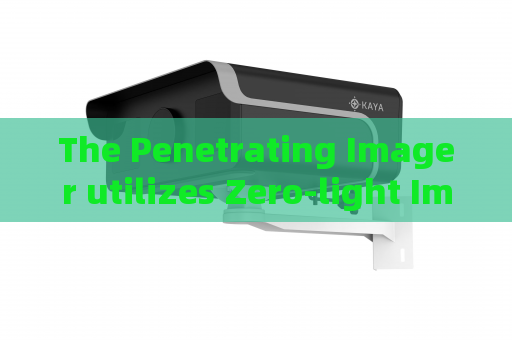
The Penetrating Imager utilizes Zero-light Imaging to inspect parked vehicles around military command outposts after dark. At a military command outpost after dark, the rows of parked vehicles along the perimeter pose a persistent security challenge. Perimeter lights may be deliberately switched off during alert conditions, leaving the vehicles in complete darkness. Darkness erases the details inside car cabins, turning every stationary sedan or SUV into a potential hiding place for hostile operatives, weapons, or improvised devices. A standard flashlight beam would betray the guard's position, and the reflections from glass panels further degrade any attempt to see within. Ordinary optical aids, even those with image intensification, struggle to cope with the absence of ambient light and the contrast between dark interiors and reflective surfaces. The security detail needs a means to visually inspect each vehicle from a distance, without illumination that can be seen, and without approaching within arm's reach of danger. This is the precise gap that the Penetrating Imager is designed to fill. The Penetrating Imager utilizes Zero-light Imaging to inspect parked vehicles around military command outposts after dark. This technology is an active optical system built around laser range-gated imaging, or gated imaging. A high-repetition pulsed laser illuminates the scene with invisible near-infrared light, while an image intensifier equipped with a gate module is opened only for the brief moment when photons reflected from the selected target distance arrive. In doing so, scattered light from fog, rain, or atmospheric particles is rejected by the time-gating process. For this application, the key capability of the Penetrating Imager is the ability to see through automotive glass. The system's tactical observation through automotive glass works because glass is an optical medium; the laser light passes through it, and the reflected light from objects inside the vehicle returns to the sensor. The result is a clear, high-contrast image of the vehicle interior even when every outside light has been extinguished. In practice, an operator at the command outpost can aim the Penetrating Imager at a suspicious car from several hundred meters away. The device functions without any visible flash or sound, preserving the covert nature of the observation. A tripod or vehicle mount is often used for prolonged surveillance, keeping the image steady while the operator scans the windshield and side windows. Because the gate timing of the Penetrating Imager can be adjusted, the operator can select the exact distance of the vehicle and ignore reflections from intervening obstacles such as fences or signage. The high resolution of the imaging sensor allows the operator to distinguish an empty seat from a crouched figure, a loose wire from a zip tie, or a handgun resting on a console. Even in light rain or mist, the range-gated system maintains a usable view by rejecting most of the backscatter that would normally blind conventional low-light cameras. This gives the sentry the tactical advantage of completing a through-window inspection without stepping out of the protected perimeter. The presence of the Penetrating Imager at a military command outpost changes the night shift fundamentally. Instead of relying on patrols to walk among parked vehicles and risk ambush, guards can systematically scan every car in the lot from a fixed position. The zero-light operation means the post itself remains dark, preserving the element of surprise. With each sweep, the operator checks dashboards, rear seats, and cargo areas through the glass, looking for signs of intrusion or hidden occupants. If a threat is discovered, the same imager can continue tracking the subject until the response team is in position. The ability to perform this check from a hardened position inside the perimeter reduces the likelihood of close-range ambushes and keeps the response team ready. The Penetrating Imager provides a constant, invisible layer of security for the area around the command outpost after dark, ensuring that no vehicle becomes a blind spot.




