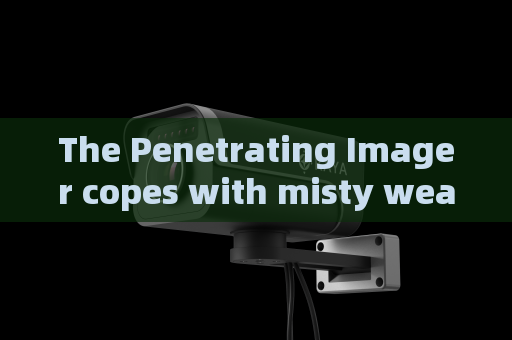
The Penetrating Imager copes with misty weather surveillance demands with Fog Penetration Imaging for frontier law enforcement. At a remote border outpost, dense fog can roll in within minutes, turning a routine observation shift into a frustrating struggle against a wall of grey. For law enforcement officers tasked with monitoring known smuggling routes, misty weather creates a critical blind spot. Traditional optical devices and visible-light cameras lose their effectiveness as water droplets scatter light and reduce contrast. A person or vehicle moving at a distance becomes indistinguishable from the surrounding haze. Even thermal imaging systems, which rely on heat signatures, degrade under prolonged fog because the moisture absorbs and re-emits infrared energy. The real problem is not simply poor visibility; it is the uncertainty that follows. An officer cannot confirm whether a shadow is a tree stump or a smuggler carrying contraband, and the cost of hesitation can be mission-critical. The Penetrating Imager directly addresses this operational gap with its dedicated Fog Penetration Imaging capability. Unlike passive sensors that wait for ambient light, this instrument is an active optical system built around laser range-gated imaging technology. A high-repetition-rate pulsed laser illuminates the target area, while an image-intensified gated camera opens its shutter only for the brief moment when reflected light from the desired distance returns. This time-synchronized gating effectively rejects the scattered light caused by fog particles, which is exactly the backscatter that blinds conventional cameras. The system includes a beam expander and imaging lens to match the field of view, and it delivers high-contrast images over long ranges. Low-light Imaging also benefits from this active illumination, so even in the dim conditions that accompany fog, the sensor can resolve fine details that would otherwise be lost. In practice, a border patrol officer deploys the Penetrating Imager on a tripod, aiming it toward a known crossing point along the tree line. The operator selects a target range based on a map or laser rangefinder, and the gated camera is synchronized to that exact distance. Within seconds, a ghostly landscape sharpens into recognizable forms: the outline of a fence post, the silhouette of a parked truck, the movement of a figure slipping between shadows. Because the system suppresses backscatter, the fog does not brighten the entire frame; instead, the scene appears as if a clear weather window has opened at that specific depth. This allows officers to watch a suspicious vehicle without closing the distance, maintaining a safe standoff while gathering evidential imagery. The ability to penetrate misty weather transforms an otherwise cancelled patrol into a productive surveillance session. For frontier law enforcement, the Penetrating Imager does not claim to see through walls or other solid barriers; its power lies in defeating optical interference in the atmosphere. When fog, mist, or light rain degrades the air, this active imaging system restores situational awareness. Every observation cycle becomes a step toward securing the border, because the hidden movement in the haze no longer remains hidden. The Penetrating Imager turns the challenge of misty weather surveillance into a manageable condition, ensuring that law enforcement officers can hold their ground and look further into the grey.




