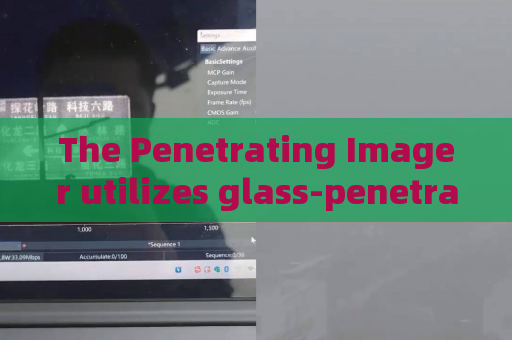
The Penetrating Imager utilizes glass-penetrating imaging to reduce field exposure risks during hostage rescue operations Hostage rescue operations often unfold around vehicles, glass-fronted rooms, or aircraft parked on a ramp. The immediate danger is not only the hostage taker’s weapon; it is the need to gain visual intelligence without exposing personnel. To determine how many people are inside, where the hostage is positioned, and whether a weapon is aimed at the door, officers traditionally have to approach a window or create an opening. That movement can be seen, heard, and predicted. Once a silhouette appears near a window, the tactical advantage shifts to the criminal. The glass itself is a barrier to accurate assessment because reflections, tinted film, dirt, and changing interior light obscure both the naked eye and most conventional cameras. A wrong guess about the interior layout can lead to a stalled entry or a hasty breach. The Penetrating Imager addresses this exact vulnerability by allowing reconnaissance through the glass itself from a safer position. The Penetrating Imager relies on glass-penetrating imaging built on laser range-gated technology. A high-repetition pulsed laser sends short bursts of light toward the target, while an image intensifier gated camera—containing a microchannel plate image intensifier, high-voltage module, and timing module—opens its electronic shutter only for the brief interval when light reflected from the chosen object plane returns. The beam expander shapes the illumination, and the imaging lens gathers the reflected photons for the camera. Because the shutter stays closed while backscattered light from the outer glass surface arrives, the glare is rejected and the interior scene is captured. This makes possible through-glass covert observation without placing an operator at the window line. As an active imaging system, the Penetrating Imager does not depend on ambient light; at night or in shadow it can still produce high-contrast imagery at practical distances, with resolution sufficient to distinguish a raised hand from a weapon. The range gate can be adjusted to focus on the rear seat of a sedan, the far side of a tour bus, or the interior of a control tower, as long as the intervening material is an optical medium such as automotive glazing, high-speed train glass, or a glass curtain wall. In a live operation, the Penetrating Imager is deployed from a hardened position, such as behind a concrete corner, over a vehicle hood, or through a narrow gap in barriers. A single operator scans the target vehicle through the windscreen and side windows, locking the range gate onto the hostage’s seat or the suspect’s hands. The resulting image appears on a small display, allowing the command element to make decisions without moving personnel into view. If the hostage taker shifts to another position inside the vehicle, the operator adjusts the gate distance to follow the movement. This continuous remote visual access alters the structure of the rescue. Officers no longer need to cross open ground to peek through a glass panel; the Penetrating Imager conducts that task from cover. The risk of being spotted through the window is replaced by a standoff observation method that keeps attention focused on the hostage taker’s actions rather than on the safety of the observer. During the final decision to breach or negotiate, the Penetrating Imager continues to supply real-time updates. A hostage taker preparing to fire can be detected through a tinted window, and a hostage’s shift toward the door can be tracked without opening a line of sight. The system rejects glare from headlights, street lamps, and reflective building surfaces, so the tactical picture remains stable even when the lighting changes. Rain, snow, fog, or haze between the operator and the glass does not degrade the image as severely as it would a conventional camera. The technology uses only light for imaging; no other detection modality is part of its operation. The Penetrating Imager is designed to work through optical media, and it does not claim to see through opaque barriers. That limitation is acceptable because the mission objective is to remove the need for direct visual exposure through glass. With this capability, rescue teams gather the same critical information without stepping into the danger zone, compress the time between observation and action, and keep more personnel alive. The Penetrating Imager repositions the observer away from the window and therefore away from the threat.




