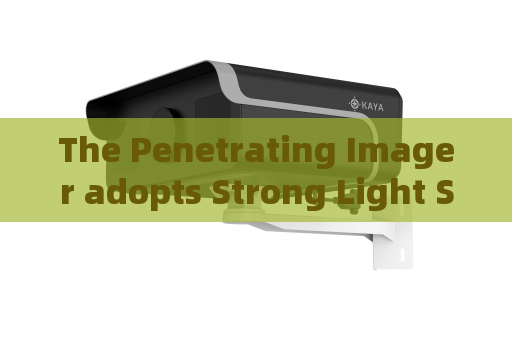
The Penetrating Imager adopts Strong Light Suppression Imaging for vehicle inspection under highway backlight conditions A highway patrol officer stops a sedan just after sunset on a flat, west-facing stretch of asphalt. The low sun sits directly behind the target vehicle, and the windshield has become a blinding mirror. Every detail of the cabin—the driver’s hands, the passenger’s posture, the shapes on the rear seat—is swallowed by the wash of scattered sunlight. This is the everyday reality of vehicle inspection under highway backlight conditions. The officer cannot see whether the driver is reaching for a document or for something else. The careful choreography of a traffic stop, designed to keep distance and control, breaks down because information is unavailable at the most critical instant. Standard lighting tools and conventional cameras fail here, because the issue is not darkness but overwhelming glare. The situation demands an instrument that can reject the reflected sunlight and inspect the interior through the glass itself. The Penetrating Imager is built for exactly this task, using coherent pulsed light and an ultrafast optical gate to strip away the backscatter that blinds every conventional line of sight. The Penetrating Imager adopts Strong Light Suppression Imaging to address this failure mode directly. At its core lies a laser range-gated imaging architecture: a high-repetition pulse laser illuminates the cabin volume, and an image intensifier camera containing an MCP intensifier, a high-voltage module, and an internal timing unit acts as a shutter that opens for only a few nanoseconds at the precise moment when reflected light returns from the selected depth. In the highway backlight scenario, the operator sets this gate to the distance of the vehicle interior—the windshield plane or the rear window. Light reflected by the shiny glass surface, as well as the overwhelming sunlight scattered from dust and heat shimmer along the roadway, arrives outside this narrow time window and is rejected. What survives is a high-contrast image of the occupied cabin itself. This through-glass surveillance capability is not a software afterthought; it is a physical selection of returning photons, which is why the captured frames stay clean even with the sun positioned directly behind the suspect vehicle. During a live inspection, the Penetrating Imager is mounted on a tripod beside the patrol unit or held by a second officer at the fender line, preserving a clear optical path to the suspect glass. The range gate is fine-tuned until the dashboard, the front seats, and the occupants’ arms appear in sharp relief on the operator display. Strong Light Suppression Imaging guarantees that neither the specular reflection of the low sun off the curved windshield nor the secondary reflection from the rear glass overpowers the scene. Because the system carries its own pulsed laser source, image quality remains consistent as daylight fades through dusk and into artificial street lighting, and the deep gating rejects the wide background glow of an open highway. The operator can freeze a frame, zoom into a specific seat corner, and record the sequence for later documentation without ever approaching the vehicle. This makes the Penetrating Imager equally reliable for covert through-glass recon during the approach phase: officers confirm the number of occupants, the position of hands on the steering wheel, and the presence of objects on seats before leaving a covered position. The deeper value of the Penetrating Imager in highway backlight vehicle inspection lies in restoring tactical initiative to the officers. The Penetrating Imager sees through factory glass and aftermarket window film alike, so the inspection no longer depends on the sun angle or the reflectivity of a particular windshield. From behind a barrier, on a median strip, or in the middle of a checkpoint lane, the operator watches a live, real-time picture of the interior and issues specific calm commands—keep both hands on the wheel, turn toward the passenger window, open the door from the outside—without walking into an invisible situation. The same gated view continues throughout the approach to the window, maintaining continuous observation as the officer closes the final distance. The Penetrating Imager, built from a pulse laser, a gated intensifier camera, a beam expander, and an imaging lens, converts the most dangerous moment of a traffic stop into the most observable one. Under highway backlight glare, where every detail hides in plain light rather than in shadow, it keeps the glass transparent and the risk visible.




